Last updated on September 12th, 2026 at 10:06 am
According to the Cambridge Dictionary, the term ‘complex’ means difficult to understand because it has many different parts.
The complex sentence, however, is not too difficult to understand once you learn its structure. Let’s look at the definition below.
Definition of a Complex Sentence
Quick Navigation
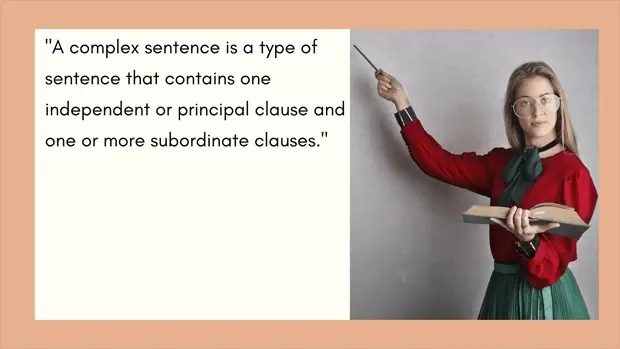
A complex sentence is a type of sentence that contains one independent (or principal) clause and one or more subordinate clauses.
In other words, a simple sentence consists of one independent clause, whereas a complex sentence consists of one independent clause plus one or more dependent clauses.
Now you may have a question: Where do we need to use a complex sentence? The simple answer is whenever you need to explain a thing elaborately, then you can use complex sentences. For example:
- I was reading the book when everyone was leaving the library.
Note: ‘I was reading the book’ is an independent or principal clause and it depicts the complete meaning though. But after adding the subordinate clause (when everyone was leaving the library) it’s more elaborate.
Difference Between Simple & Complex Sentences
It’s easy to spot the difference between simple and complex sentences. A simple sentence contains only one independent clause, while a complex sentence contains one independent clause plus one or more subordinate clauses.
Subordinate clauses are introduced by subordinating conjunctions or relative pronouns. The table below groups the most common ones by the relationship they show.
| Type | Common Conjunctions | Example |
|---|---|---|
| Time | when, while, before, after, until, as soon as | When he gets enough time, he meets with his friends. |
| Cause / Reason | because, since, as | Since I was nervous, I enjoyed the program. |
| Condition | if, unless, in case | I will wait for you if you come here. |
| Contrast / Concession | although, though, even though | Though she felt sick, she attended the meeting. |
| Place | where, wherever | She stayed where she felt safe. |
| Manner | as if, as though | He wore a dress as if he had become the king. |
| Relative pronoun | who, which, that | I think that he is a brilliant student. |
We can easily make a complex sentence by combining two simple sentences with a subordinating conjunction. For example:
- I missed you after you had left me.
Note: ‘ I missed you‘ and ‘you had left me‘ these two are simple sentences converted to a complex sentence by adding a subordinate clause (after).
Difference Between Complex and Compound Sentences
Sometimes, we become confused about differentiating between complex and compound sentences because they consist of two clauses. But it’s not too complicated to identify a complex and a compound sentence.
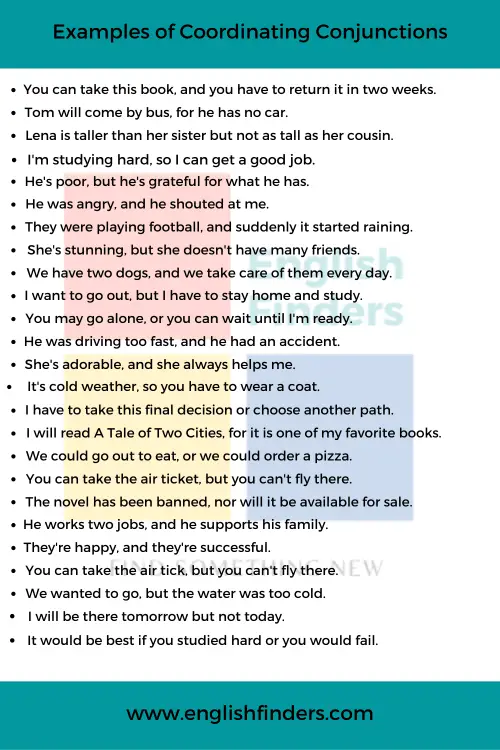
A compound sentence contains two independent (or principal) clauses joined by a coordinating conjunction like and, but, or (I have a car and take care of it).
A complex sentence, on the other hand, contains an independent clause and a dependent clause (I have a car that I bought from the local market).
Examples of Complex Sentences
Let us see some examples of complex sentences:
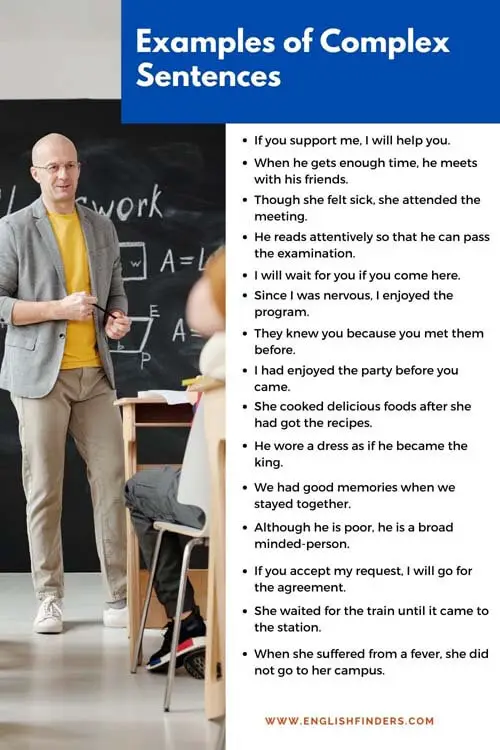
- If you support me, I will help you.
- When he gets enough time, he meets with his friends.
- Though she felt sick, she attended the meeting.
- He reads attentively so that he can pass the examination.
- I will wait for you if you come here.
- Since I was nervous, I enjoyed the program.
- They knew you because you had met them before.
- I had enjoyed the party before you came.
- She cooked delicious food after she had gotten the recipes.
- He wore a dress as if he had become the king.
- We had good memories when we stayed together.
- Although he is poor, he is a broad-minded person.
- If you accept my request, I will go for the agreement.
- She waited for the train until it came to the station.
- She did not go to her campus when she suffered from a fever.
- I accepted her request because she needed my assistance.
- Your boss promoted you to your position when you approached him.
- Though it’s winter, I feel a warm atmosphere.
- She waited for you till you came.
- I think that he is a brilliant student.
Note: If a complex sentence starts with a subordinate or dependent clause then a comma (,) is placed right before the independent or principal clause. If a complex sentence starts with an independent or principal clause then no need to place a comma (,).
Common Mistakes to Avoid
A few small errors show up often when writers first start using complex sentences. Here’s what to watch for:
- Confusing complex with compound sentences: a complex sentence joins an independent clause with a dependent clause, not two independent clauses.
- Missing the comma after a fronted clause: when the dependent clause comes first, place a comma before the independent clause (e.g., “Since I was nervous, I enjoyed the program.”).
- Adding an unnecessary comma: when the independent clause comes first, a comma is usually not needed before the dependent clause (e.g., “I enjoyed the program since I was nervous.”).
- Writing a dependent clause as its own sentence: a clause like “Because I was late” is a fragment, not a complete sentence, unless it’s attached to an independent clause.
Frequently Asked Questions
What is a complex sentence?
A complex sentence is a sentence that joins one independent clause with one or more dependent (subordinate) clauses, usually connected by a subordinating conjunction or relative pronoun.
What are subordinating conjunctions?
Subordinating conjunctions introduce a dependent clause and show how it relates to the main clause — for example, because, although, when, if, and since show reason, contrast, time, and condition.
What is the comma rule for a complex sentence?
If the dependent clause comes before the independent clause, use a comma between them. If the dependent clause comes after the independent clause, a comma is usually not needed.
What is the difference between a complex sentence and a compound sentence?
A compound sentence joins two independent clauses of equal weight. A complex sentence joins one independent clause with one or more subordinate clauses.
Quiz

Continue Learning
Related Articles

- 50 Words Ending in Less | Meanings, Examples, and Worksheet - July 26, 2026
- 5 Letter Words with 3 Vowels: 200+ Words with Meanings and Examples - July 11, 2026
- 100 Words Ending in Ful: Meanings, Example Sentences, and Worksheet - May 29, 2026