
Last updated on September 4th, 2026 at 10:55 pm
Sentences are divided into many types, and the compound sentence is one of them. Compound sentences play a significant role in explaining a thing more elaborately.
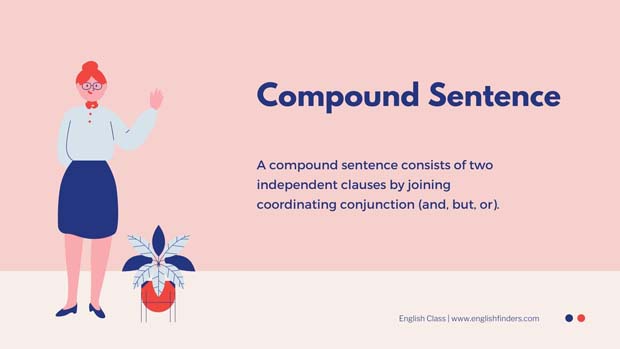
A compound sentence consists of two independent clauses joined by a coordinating conjunction (and, but, or). A clause is a group of words that has an independent meaning.
Many of us think a compound sentence is complicated, but it’s actually not that difficult to understand. Let’s start with the definition.
What Is a Compound Sentence in English?
Quick Navigation
A compound sentence is a type of sentence that consists of two independent clauses with a coordinating conjunction (and, but, or). In other words, we can say a compound sentence has two main clauses joined by a comma and a coordinating conjunction or a semicolon.
We can also make a compound sentence by joining two simple sentences with a comma and a coordinating conjunction. Let us see some examples to get a clear idea of it:
- I prepare for dinner, and I enjoy the wedding party.
- She knew how to fix the issue, but she refused to do it.
- You will have to do the proper diet, or your weight will be increased.
- Make a good study plan; otherwise, you will fail the examination.
- I need your assistance; I cannot proceed without it.
Coordinating Conjunctions (FANBOYS)
Compound sentences are joined using one of seven coordinating conjunctions, remembered with the acronym FANBOYS:
| Letter | Conjunction | Example |
|---|---|---|
| F | For | She left early, for she had an early flight. |
| A | And | I prepare for dinner, and I enjoy the wedding party. |
| N | Nor | He doesn’t like tea, nor does he like coffee. |
| B | But | She knew how to fix the issue, but she refused to do it. |
| O | Or | You will do the proper diet, or your weight will increase. |
| Y | Yet | He has lost his job, yet he didn’t get his last salary. |
| S | So | My friend is busy now, so I have to meet him later. |
Structure of a Compound Sentence
There are three ways to join the two independent clauses in a compound sentence:
| Method | Structure | Example |
|---|---|---|
| Comma + coordinating conjunction | Clause + , + FANBOYS + clause | He plays football, and his friend reads a novel. |
| Semicolon | Clause + ; + clause | She lives in the USA; her family stays in the UK. |
| Semicolon + conjunctive adverb | Clause + ; + however/therefore + , + clause | He studied hard; however, he failed the exam. |
We can quickly identify the difference between simple and compound sentences. A simple sentence contains one independent clause, e.g., I need this English lesson.
In contrast, a compound sentence contains two independent clauses with a coordinating conjunction, e.g., I need this English lesson, and you can provide me with this lesson.
Difference between Complex and Compound Sentences
Sometimes we become confused about how to differentiate between complex and compound sentences. But it’s not a difficult task to identify the difference between these two sentences. A complex sentence contains one independent clause and one or more subordinate clauses. For example;
I have a pet whom I love so much.
We can see one independent clause and a subordinate clause in this sentence. That’s why we can call it a complex sentence.
On the other hand, a compound sentence contains two independent clauses with a coordinating conjunction. For example;
I have a pet, and I love it so much.
In this sentence, we can see two independent clauses combined with the coordinating conjunction ‘and.’ That’s why we call it a compound sentence.
Examples of Compound Sentences
Now let us see some examples of compound sentences for better understanding:
- He plays football, and his friend reads a novel.
- They worked hard, but they failed to reach their destination.
- I need to work with you, but I can’t due to my sickness.
- We should complete the task or fail to reach our destination.
- My friend is busy now, so I have to meet him later.
- He has lost his job, yet he didn’t get his last salary.
- I found the right path and got my best life partner.
- She knew the true story, but didn’t want to unveil it.
- Kareem will buy a bike, or he will buy a car.
- Jareen loves to read novels, and she reads a novel every week.
- We have to finish our project on time, yet we have a lot of tasks at hand.
- They provide voluntary services, and they have many members.
- She has suffered from a disease, and she missed her loving family.
- He had a happy moment with his friends but missed his pet.
- I know you’re missing me, but I have no way to meet with you.
- He’ll be playing with team members or choosing a different option.
- We’re trying to invent a new technology, yet we need many types of equipment.
- Archer kept my word, and I was happy to see him.
- Please don’t lose your last hope; we’ll never reach your destination.
- She lives in the USA, and her family stays in the UK.
Common Mistakes to Avoid
- Comma splices. Joining two independent clauses with only a comma is a common error — “It was raining, we stayed inside” needs a coordinating conjunction: “It was raining, so we stayed inside.”
- Run-on (fused) sentences. Joining two independent clauses with no punctuation at all — “It was raining we stayed inside” — is a fused sentence. Add a comma and conjunction, a semicolon, or split it into two sentences.
- Connecting unrelated ideas. A compound sentence should join two clauses that are logically related — “I like pizza, and Paris is in France” is grammatically valid but reads as disconnected.
- Overusing “and.” Stringing together many clauses with repeated “and” makes writing monotonous — vary the coordinating conjunction or split into separate sentences.
Frequently Asked Questions
What is a compound sentence?
A compound sentence is a sentence that joins two independent clauses using a coordinating conjunction, a semicolon, or a semicolon with a conjunctive adverb.
What are the coordinating conjunctions used in compound sentences?
The seven coordinating conjunctions, remembered with the acronym FANBOYS, are for, and, nor, but, or, yet, and so.
What is the difference between a compound and a complex sentence?
A compound sentence joins two independent clauses of equal weight. A complex sentence joins one independent clause with one or more subordinate clauses.
What is a comma splice?
A comma splice is the error of joining two independent clauses with only a comma instead of a comma plus a coordinating conjunction, a semicolon, or a period.
Compound sentences are useful writing tools because they allow the joining of two independent clauses using coordinating conjunctions like “and,” “but,” or “or.” Using this kind of sentence structure, we can describe linkages between ideas and more thorough explanations.
Compound sentences can be easily distinguished from simple sentences, which only have one independent clause, by understanding their definition and examples. Furthermore, we can distinguish compound sentences from complex ones containing independent and subordinate clauses.
The examples given show us how compound sentences improve the cohesion and clarity of our writing. We can effectively communicate our thoughts and ideas more thoroughly and interestingly by using compound sentences in our writing.
Continue Learning
Compound Sentences Quiz

- Synecdoche: Meaning, Pronunciation and Examples - October 20, 2026
- Metonymy: Meaning, Types and Examples in the News - October 20, 2026
- Figures of Speech: Meaning, Types and Examples - October 19, 2026