
Last updated on September 4th, 2026 at 02:47 pm
The past perfect tense (also called the past perfect simple) shows that one action in the past happened before another past action. It’s formed with had + the past participle of the main verb.
It’s one of the most useful tenses for telling a story in the right order, writing narratives, and expressing what had already happened by a certain point in the past.
Below you’ll find a clear explanation of the structure, when to use it, 50 example sentences you can study or adapt, common mistakes to avoid, and answers to the questions learners ask most often.
What Is the Past Perfect Tense?
Quick Navigation
The past perfect tense describes an action, event, or state that was already completed before another point or action in the past.
If you’re describing two past events, the one that happened first goes in the past perfect. The one that happened second — the “main” event — stays in the simple past.
This makes the sequence of events clear to the reader or listener.
For example: “By the time I arrived, she had already left.” Here, “had left” (past perfect) happened before “arrived” (simple past) — the past perfect signals which action came first.
Structure of the Past Perfect Tense (Formula)
| Sentence Type | Structure | Example |
|---|---|---|
| Affirmative | Subject + had + past participle | She had left before I arrived. |
| Negative | Subject + had not (hadn’t) + past participle | She hadn’t left when I arrived. |
| Question | Had + subject + past participle? | Had she left before you arrived? |
When to Use the Past Perfect Tense
- To show which of two past actions happened first — “He had finished dinner before I called.”
- With time words like before, after, by the time, already, just, and until — “They had already eaten by the time we arrived.”
- In reported (indirect) speech, when the original statement was in the past or present perfect — “She said she had visited Paris.”
- To explain the reason behind a past situation — “He was tired because he had worked all night.”
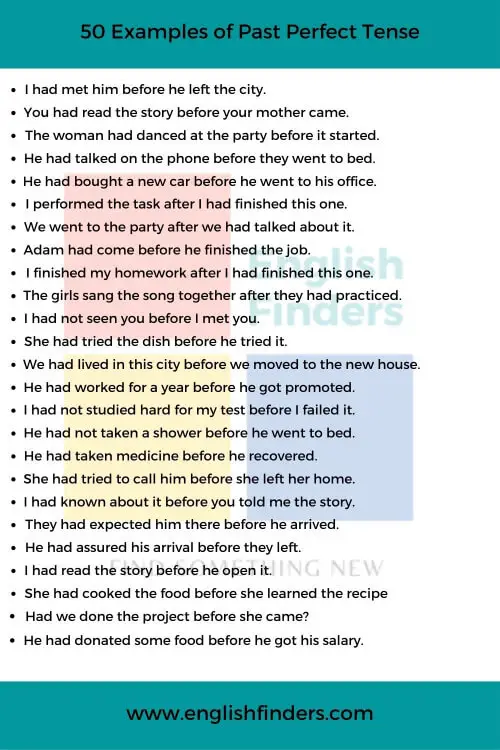
50 Examples of Past Perfect Tense
Let’s look at 50 example sentences using the past perfect tense to understand it clearly. Notice how each sentence has two past actions, and the past perfect (“had + past participle”) marks the one that happened first.
- I had seen him before he left the city.
- You had read the story before your mother came.
- The woman had danced at the party before it started.
- He had talked on the phone before they went to bed.
- The girl had gone to school before her father woke up from sleep.
- He had bought a new car before he went to his office.
- His wife had cooked a meal before he arrived home.
- I performed the task after I had finished this one.
- We went to the party after we had talked about it.
- Adam had come before he finished the job.
- I finished my homework after I had finished this one.
- The girls sang the song together after they had practiced.
- I had not seen you before I met you.
- The students had attended school before they went on vacation.
- She had finished the task before he entered the room.
- The workers had completed the project before they went home.
- She had tried the dish before he tried it.
- We had done our project before we went to the party.
- We had lived in this city before we moved to the new house.
- He had worked for a year before he got promoted.
- She had read that book before she read another one.
- They had decided to go there before they changed their mind.
- I had not studied hard for my test before I failed it.
- We ate our dinner after she had arrived home from work.
- She had not seen that movie before she went to the theater.
- They had not done their homework before they went to bed.
- He had not taken a shower before he went to bed.
- We had seen the movie a few months ago before he saw it.
- They had played with him long before they became his friends.
- I had worked hard on my project before I got it approved.
- We had waited for her long before she arrived home.
- He had taken medicine before he recovered.
- She had tried to call him before she left her home.
- He had practiced the song before he played it at the concert.
- They had waited for him before they started their meeting.
- They had finished their work before they went on vacation.
- I had known about it before you told me about it.
- They had expected him there before he arrived.
- You had bought a new car before you sold your old one.
- I had concentrated on my engagement before I found out.
- He had assured his arrival before they left.
- I had read the story before he opened it.
- You had played well before he started playing.
- They had watched the program before I watched it.
- She had cooked the food before she learned the recipe.
- We had made the decision before he came.
- He had donated some food before he got his salary.
- Had we done the project before she came?
- By the time the guests arrived, we had already decorated the whole house.
- The train had left the station before we reached the platform.
- She realized she had forgotten her keys after she locked the door.
Common Mistakes to Avoid
- Using it for a single past action. If there’s only one past event, use the simple past instead (“I ate breakfast,” not “I had eaten breakfast,” unless a second past action follows).
- Forgetting the correct past participle. Irregular verbs (go → gone, see → seen, eat → eaten) don’t follow the regular “-ed” pattern.
- Overusing the past perfect in casual narration. If the order of events is already clear from context or words like “then” and “after,” the simple past is often more natural.
- Mixing up had (past perfect) with has/have (present perfect). Past perfect always refers to a time before another point in the past — not the present.
Frequently Asked Questions
What is the difference between the past perfect and the simple past?
The simple past describes a single completed action (“I ate breakfast”). The past perfect describes an action that happened before another past action (“I had eaten breakfast before I left”).
How do you form the negative of the past perfect tense?
Add “not” after “had”: subject + had not (hadn’t) + past participle. Example: “She hadn’t finished her homework when I called.”
How do you form a question in the past perfect tense?
Put “had” before the subject: Had + subject + past participle? Example: “Had you left before the meeting started?”
When should you avoid using the past perfect tense?
Avoid it when there’s only one past event, or when the sequence of events is already obvious from context — in those cases, the simple past reads more naturally.
Continue Learning

- Flashback: Meaning, Examples and How to Write One - October 16, 2026
- Circular Reasoning: Meaning, Examples and How to Spot It - October 14, 2026
- False Dilemma: Meaning, Examples and How to Respond - October 14, 2026