
Last updated on November 22nd, 2026 at 08:46 am
You meet a friend in the park. Their face is red, and they are out of breath. “Sorry,” they say. “I’ve been running.” The run is over, but you can still see the result. That sentence uses the present perfect continuous tense.
This page shows how to form the tense and when to use it. It gives 50 natural examples, grouped by use, and compares the tense with the present perfect. A quiz at the end checks what you learned.
- How to form positive, negative and question sentences
- The four main uses of the tense
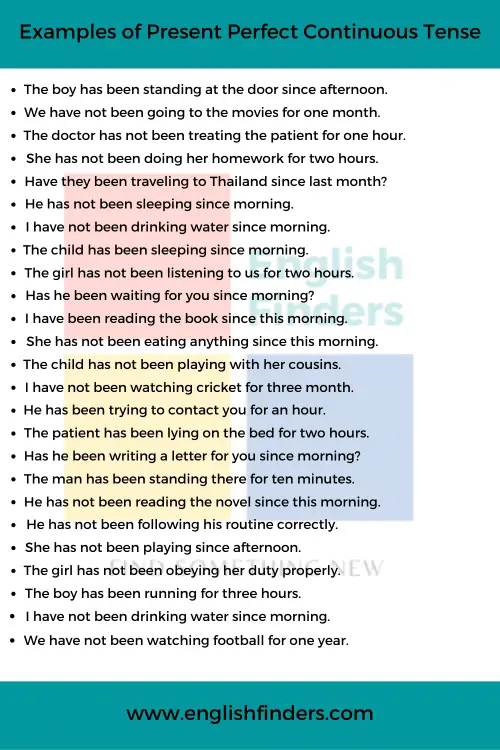
- 50 natural example sentences, grouped by use
- When to use for and when to use since
- How it differs from the present perfect, and which verbs do not use it
What Is the Present Perfect Continuous Tense?
Quick Navigation
The present perfect continuous connects the past and the present. It focuses on an activity and how long it has been going on. The action may still be happening, or it may have just stopped.
- I have been waiting for an hour. (I am still waiting.)
- It has been raining. (The rain has stopped, but the streets are wet.)
Structure of the Present Perfect Continuous Tense (Formula)
| Sentence type | Structure | Example |
|---|---|---|
| Positive | Subject + has/have + been + verb-ing | She has been studying since 6 p.m. |
| Negative | Subject + has/have + not + been + verb-ing | She hasn’t been studying for long. |
| Question | Has/have + subject + been + verb-ing? | Has she been studying all evening? |
Use has with he, she and it. Use have with I, you, we and they. In speech, people use short forms: I’ve been, you’ve been, he’s been, she’s been, it’s been, we’ve been, they’ve been.
When to Use the Present Perfect Continuous Tense
- An action that started in the past and is still going on: I have been living here since 2020.
- An action that just stopped and has a result now: I’m tired because I have been working all day.
- Recent repeated actions or habits: She has been going to the gym a lot lately.
- To ask or say how long: How long have you been waiting?
50 Examples of Present Perfect Continuous Tense
Actions That Are Still Going On
- I have been learning English for three years.
- She has been waiting for the bus since 8 a.m.
- They have been living in Chattogram since 2020.
- He has been working at the bank for five years.
- We have been studying for the exam all week.
- It has been raining since this morning.
- The baby has been sleeping for two hours.
- My brother has been playing the guitar since he was ten.
- I have been reading this book for a week.
- The children have been playing outside all afternoon.
- She has been teaching at this school for twelve years.
- They have been building the new bridge since last year.
- I have been saving money for a new phone.
- The company has been growing quickly this year.
- Scientists have been studying the virus since it was discovered.
Actions That Just Stopped, With a Result Now
- I’m tired because I have been running.
- The ground is wet. It has been raining.
- Her hands are dirty because she has been gardening.
- He is out of breath because he has been climbing the stairs.
- The kitchen smells great. Someone has been baking.
- Sorry I’m late. I have been talking to my manager.
- My back hurts because I have been sitting at my desk all day.
- Their clothes are wet because they have been swimming.
- The phone is hot because I have been using it for hours.
- There is paint on her shirt. She has been painting her room.
Recent Habits and Repeated Actions
- I have been sleeping badly lately.
- She has been going to the gym a lot recently.
- We have been eating more vegetables lately.
- He has been working late every night this month.
- They have been spending a lot of time together recently.
- I have been feeling much better lately.
- My sister has been practicing the piano every evening.
- The team has been playing really well this season.
Negative Sentences
- I haven’t been sleeping well lately.
- She hasn’t been feeling well since Monday.
- We haven’t been watching much TV recently.
- He hasn’t been coming to class regularly.
- They haven’t been talking to each other since the argument.
- You haven’t been listening to me!
- The printer hasn’t been working properly this week.
- I haven’t been waiting long. I just got here.
Questions
- How long have you been learning English?
- Have you been crying? Your eyes are red.
- What have you been doing all day?
- How long has she been working here?
- Has it been raining all night?
- Who have you been talking to?
- Have they been waiting for long?
- Why have you been avoiding me?
- Where have you been living since you moved?
For or Since?
| Word | Use it with | Examples |
|---|---|---|
| For | A length of time | For two hours, for a week, for ten years |
| Since | A starting point | Since 9 a.m., since Monday, since 2020, since I was a child |
- She has been waiting for forty minutes.
- She has been waiting since 10 o’clock.
Present Perfect vs Present Perfect Continuous
| Present perfect | Present perfect continuous | The difference |
|---|---|---|
| I have read three books this month. | I have been reading all morning. | Result or number vs the activity and its length |
| She has painted the kitchen. | She has been painting the kitchen. | Finished vs maybe not finished |
| They have lived here for ten years. | They have been living here for ten years. | Both are correct; the continuous sounds more active |
| I have known him for years. | (Not used) | Know is a state verb, so it has no continuous form |
Verbs That Don’t Use This Tense
Some verbs describe states, not actions. They usually stay in the present perfect.
| Not natural | Correct |
|---|---|
| I have been knowing her for years. | I have known her for years. |
| He has been owning this car since 2018. | He has owned this car since 2018. |
| She has been believing in ghosts since childhood. | She has believed in ghosts since she was a child. |
| They have been belonging to the club for years. | They have belonged to the club for years. |
Other common state verbs are understand, like, prefer, need, seem and mean.
Common Mistakes to Avoid
- Using it with state verbs. Say “I have known her for years,” not “I have been knowing her.”
- Mixing up “for” and “since”. Use for with a length of time and since with a starting point.
- Forgetting “been”. “She has studying” is wrong. Say “She has been studying.”
- Using it with a finished time. “I have been studying yesterday” is wrong. Say “I was studying yesterday” or “I studied yesterday.”
Check your answer
Quiz: Test Yourself
- Choose the correct form: “She ___ here since 2019.”
- “I have been waiting ___ two hours.”
- “They have been living here ___ March.”
- Which sentence is correct?
- “Your eyes are red. ___ crying?”
- Which sentence focuses on a finished result?
- Choose the correct negative.
- “How long ___ you been studying English?”
- Which time word often goes with this tense?
- Choose the correct sentence.
Key Takeaways
- Form: subject + has/have + been + verb-ing.
- Use it for actions that are still going on or have just stopped with a result.
- Use for with a length of time and since with a starting point.
- State verbs like know, own and believe use the present perfect instead.
- Do not use it with finished times like yesterday or last year.
Frequently Asked Questions
What is the difference between present perfect and present perfect continuous?
The present perfect focuses on the result: I have written ten emails. The present perfect continuous focuses on the activity and how long it lasted: I have been writing emails all morning.
Can you use the present perfect continuous with state verbs?
Usually not. State verbs like know, own, believe and understand describe states, not actions, so they stay in the present perfect: I have known him for years.
When do you use for and since with this tense?
Use for with a length of time (for two hours, for a week). Use since with a starting point (since Monday, since 2020, since I was a child).
What are 10 examples of present perfect continuous?
I have been learning English. She has been waiting since 8. It has been raining. They have been living here. He has been working hard. We have been studying. I have been reading. The baby has been sleeping. You have been crying. She has been teaching for years.
Is present perfect progressive the same as present perfect continuous?
Yes. They are two names for the same tense. British books often say continuous, and American books often say progressive.
How do you make a question in the present perfect continuous?
Put has or have before the subject, then been and the -ing verb: Have you been waiting long? How long has she been working here?
Related Articles

- Lay vs Lie: The Difference, Verb Forms and Examples - November 24, 2026
- Farther vs Further: Distance, Degree and Useful Phrases - November 24, 2026
- Compliment vs Complement: Meaning, Spelling and Examples - November 24, 2026