
Last updated on October 14th, 2026 at 06:46 am
“Next June, Maria will have been teaching for ten years”. The sentence does not say that she will stop teaching. It tells us how long the teaching will have continued by that moment.
That is the job of the future perfect continuous tense. It looks ahead to a point in the future, then looks back to show how long an action will have been in progress.
This lesson covers the form, the two main uses and the difference from the future perfect. Then you get 50 examples, exercises with answers and a short quiz.
- How to build the tense with will have been and the -ing form
- The two main uses: duration up to a future moment, and the cause of a future result
- Time expressions such as by, by the time and for
- How it differs from the future perfect simple
- 50 examples, exercises with answers and a quiz
What Is the Future Perfect Continuous Tense?
Quick Navigation
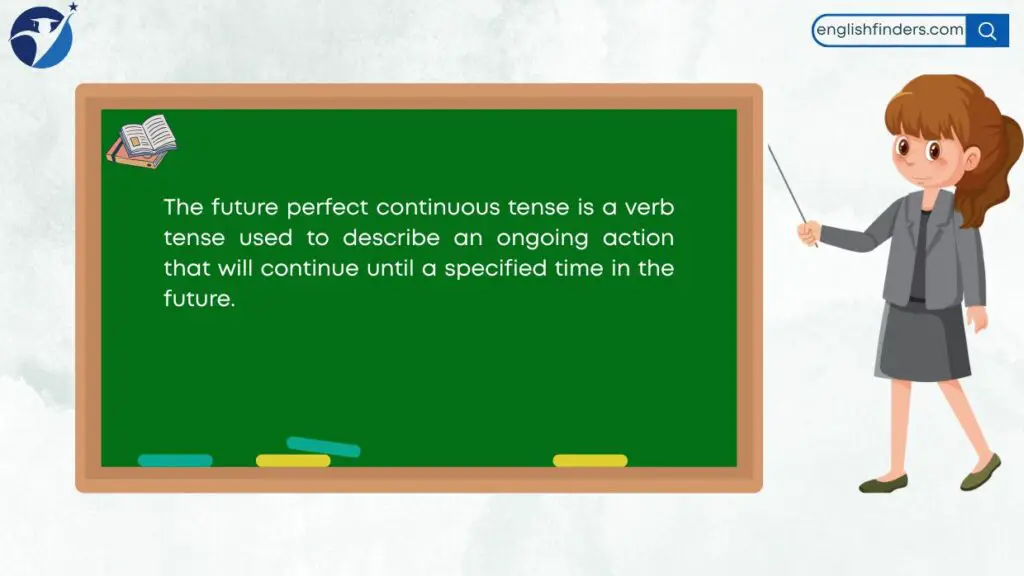
The future perfect continuous tense describes an action that begins before a future moment and is still in progress at that moment. It stresses duration: how long the action will have lasted by then.
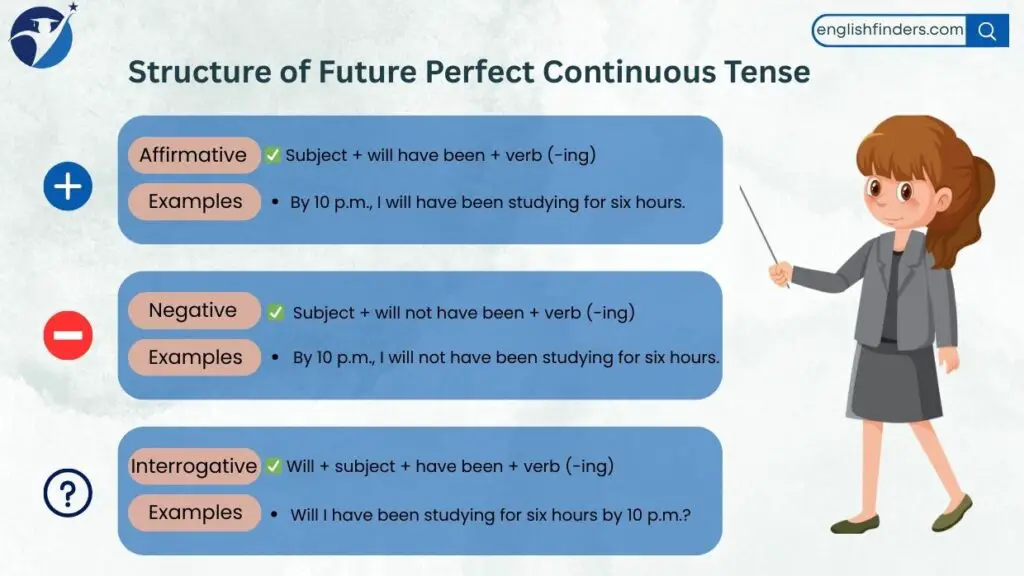
The tense uses the helping verbs will have been, followed by the -ing form of the main verb. This is the pattern for each sentence type:
| Sentence type | Formula | Example |
|---|---|---|
| Positive | Subject + will have been + verb-ing | She will have been working here for five years by December. |
| Negative | Subject + will not (won’t) have been + verb-ing | I won’t have been waiting long when you arrive. |
| Question | Will + subject + have been + verb-ing? | Will they have been traveling for ten hours by then? |
| Negative question | Won’t + subject + have been + verb-ing? | Won’t you have been working all day by then? |
In speech, will often becomes ’ll: I’ll have been working for six hours by then.
When Do We Use the Future Perfect Continuous?
There are two main uses. Both need a clear future point, such as a date, a time or another future event.
1. Duration Up to a Future Moment
Use the tense to say how long something will have been going on at a certain point in the future. The action usually started before that point and may still continue after it.
- In December, she will have been working here for five years.
- By 10 p.m., I will have been working on this project for eight hours.
- By next year, she will have been studying medicine for five years.
2. The Cause of a Future Result
A long action can explain a result at the future moment. The result is usually in the simple future, with will and the base verb.
- By next year, he will have been exercising regularly, so he will be much healthier.
- By the end of the month, she will have been practicing yoga daily, so she will feel more flexible.
- By the time we land, we will have been flying for twelve hours, so we will be exhausted.
Time Expressions to Use
| Expression | Example |
|---|---|
| By + time | By noon, I will have been studying for five hours. |
| By the time + present simple | By the time you wake up, I will have been driving for hours. |
| By next week, month or year | By next year, they will have been traveling for six months. |
| For + length of time | She will have been teaching for ten years by then. |
| When + present simple | When the coach arrives, they will have been playing for two hours. |
Positive, Negative and Question Forms
Positive Sentences
Put will have been after the subject, then add the -ing form and a time reference.
- She will have been working at the company for five years by next year.
- By 10 p.m., I will have been studying for six hours.
- When the coach arrives, they will have been playing football for two hours.
Negative Sentences
Add not after will. In speech and informal writing, we usually say won’t. Negative sentences are less common. We use them to say that an action will not have lasted as long as expected.
- They will not have been playing football for two hours by the time you arrive.
- He won’t have been waiting for long by the time we get there.
- I will not have been studying for six hours by 10 p.m., because I start at eight.
Questions and Short Answers
Put will before the subject. Wh-questions start with the question word, and how long is the most useful one.
- Will she have been working at the company for five years by next year?
- Will you have been studying for six hours by 10 p.m.?
- How long will they have been playing football when we arrive?
| Question | Short answers |
|---|---|
| Will she have been studying for three hours by noon? | Yes, she will. / No, she won’t. |
Future Perfect vs Future Perfect Continuous
Both tenses look back from a point in the future. The future perfect stresses that an action is finished, or what it achieved. The future perfect continuous stresses that the action is in progress and how long it has lasted.
For more on the first tense, see our future perfect tense examples.
| Feature | Future perfect | Future perfect continuous |
|---|---|---|
| Form | Will have + past participle | Will have been + verb-ing |
| Focus | Completion or result | Duration or ongoing action |
| Question it answers | What will be done? | How long will it have been going on? |
| Example | By 5 p.m., she will have finished the report. | By 5 p.m., she will have been working on the report for eight hours. |
| Counting things | By June, I will have read ten books. | By June, I will have been reading for a year. |
Check your answer
50 Examples of Future Perfect Continuous Tense
Each sentence names a future point and shows how long the action will have lasted by then.
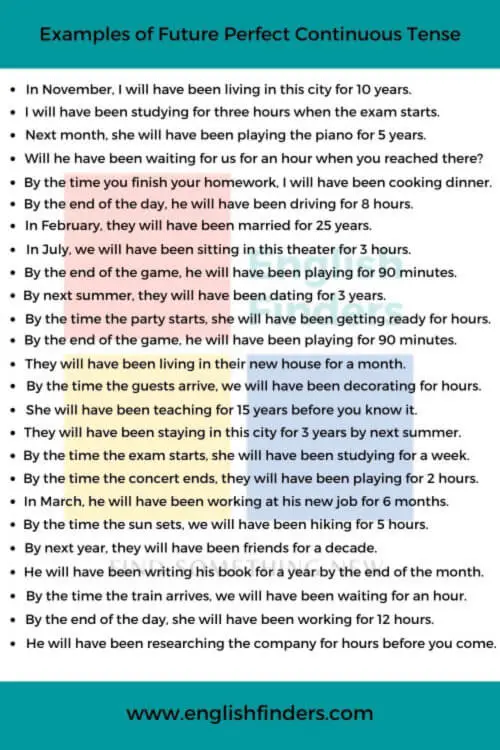
- I will have been living in this city for ten years by November.
- Tomorrow morning, he will have been studying for 12 hours straight.
- By the end of the year, we will have been working on this project for two years.
- I will not have been studying for three hours when the exam starts.
- Next month, she will have been playing the piano for 5 years.
- Will he have been waiting for us for over an hour when you get there?
- By the time you finish your homework, I will have been cooking dinner for an hour.
- He will have been driving for 8 hours by the end of the day.
- In February, they will have been running the bakery for 25 years.
- By the time the film ends, we will have been sitting in this theater for three hours.
- The employees will have been setting up for hours by the time the store opens.
- By the time the party starts, she will have been getting ready for hours.
- Will you have been traveling for 10 hours before we reach our destination?
- By the end of the game, he will have been playing for 90 minutes.
- They will have been living in their new house for a month.
- We will have been decorating for hours by the time the guests arrive.
- By the end of this school year, she will have been teaching for 15 years.
- They will have been staying in this city for 3 years by next summer.
- By the time the exam starts, she will have been studying for a week.
- By the time the concert ends, they will have been playing for 2 hours.
- He will have been working at his new job for 6 months in March.
- By the time the sun sets, we will have been hiking for 5 hours.
- She will have been practicing the guitar for 10 years.
- By next year, they will have been playing in the same band for a decade.
- By the time the event begins, they will have been planning it for months.
- He will have been writing his book for a year by the end of the month.
- They will have been running their business for 5 years.
- By the time the train arrives, we will have been waiting for an hour.
- By the end of the day, she will have been working for 12 hours.
- They will have been working in their new jobs for a month by next week.
- By the time the party ends, they will have been dancing for hours.
- In February, he will have been studying abroad for a semester.
- By the time the show starts, we will have been standing in line for an hour.
- By the end of the concert, she will have been singing for 2 hours.
- By next summer, they will have been traveling the world for a year.
- We will have been camping for 8 hours by the time the sun rises.
- She will have been working at the company for 5 years.
- Next month, they will have been learning French for a year.
- By the time the race ends, he will have been running for 3 hours.
- They will have been saving up for their dream vacation for 5 years.
- By the end of the game, they will have been playing against each other for an hour.
- When the doors open, she will have been warming up her voice for 30 minutes.
- By next summer, they will have been building their dream home for 2 years.
- By the end of the month, he will have been volunteering at the shelter for a year.
- By the time the storm passes, we will have been sheltering in the basement for two days.
- They will have been planning their wedding for 2 years by next year.
- They will have been preparing their presentation for 10 days.
- She will have been taking online classes for 6 months.
- They will have been working on their garden for 3 years.
- He will have been researching the company for hours before you come.
Common Mistakes
| Incorrect | Correct | Rule |
|---|---|---|
| She will been working for hours. | She will have been working for hours. | Keep all three words: will have been. |
| They will have been work here for a year. | They will have been working here for a year. | Use the -ing form after been. |
| Will she has been studying for long? | Will she have been studying for long? | After will, use have, never has. |
| By Friday, she will have been sending the email. | By Friday, she will have sent the email. | A one-time finished action needs the future perfect simple. |
Practice: Exercises on the Future Perfect Continuous
Exercise 1: Complete the Sentences
Write the verb in brackets in the future perfect continuous tense.
- By the time she arrives, we __________ (wait) for two hours.
- By next year, he __________ (work) at this company for a decade.
- By 5 p.m., they __________ (play) football for three hours.
- She __________ (study) for her exams for weeks by the time they start.
- By next month, I __________ (live) in this apartment for six months.
- When you get here, we __________ (cook) dinner for an hour.
- In 2030, scientists __________ (research) space travel for many years.
- When you finish your homework, your mom __________ (clean) the house for two hours.
- We __________ (drive) for eight hours by the time we reach our destination.
- By next summer, she __________ (train) for the marathon for a year.
Show answers for Exercise 1
- Will have been waiting
- Will have been working
- Will have been playing
- Will have been studying
- Will have been living
- Will have been cooking
- Will have been researching
- Will have been cleaning
- Will have been driving
- Will have been training
Exercise 2: Choose the Correct Sentence
- A) By next year, I will have been learn French for two years. B) By next year, I will have been learning French for two years.
- A) He will have been running for an hour when the sun sets. B) He will have been run for an hour when the sun sets.
- A) By the time we arrive, she will have been waiting for us for 30 minutes. B) By the time we arrive, she will have been waited for us for 30 minutes.
- A) By next year, they will have been worked on this project for three years. B) They will have been working on this project for three years by next year.
- A) The baby will have been sleeping for two hours by the time we get home. B) The baby will have sleep for two hours by the time we get home.
Show answers for Exercise 2
- B (will have been learning)
- A (will have been running)
- A (will have been waiting)
- B (will have been working)
- A (will have been sleeping)
Exercise 3: Make Sentences from the Words
Use the words in brackets to write a complete sentence in the future perfect continuous tense.
- (She / work / for six months / by next June)
- (They / practice / football / for five years / by 2030)
- (We / travel / for eight hours / by the time we reach Paris)
- (He / wait / for an hour / when the bus finally arrives)
- (I / study / for two hours / when my friend calls)
Show answers for Exercise 3
- By next June, she will have been working for six months.
- By 2030, they will have been practicing football for five years.
- By the time we reach Paris, we will have been traveling for eight hours.
- He will have been waiting for an hour when the bus finally arrives.
- I will have been studying for two hours when my friend calls.
Quiz: Test Yourself
- Which formula builds the future perfect continuous?
- What does the future perfect continuous stress?
- Which sentence is correct?
- Which sentence is correct?
- Which verb does NOT normally take the continuous form in this tense?
- Which sentence counts a finished result?
- Which is the correct negative sentence?
- Which question is correct?
- Which word completes the sentence? “___ next summer, they will have been traveling for a year.”
- “By 5 p.m., she will have been working on the report for eight hours.” Which question does this sentence answer?
Key Takeaways
- Build the tense with will have been + verb-ing.
- Use it to show how long an action will have been in progress at a future point.
- The two main uses are duration and the cause of a future result.
- Use the future perfect simple for finished results, counted things and state verbs.
- After by the time and when, use the present simple.
Frequently Asked Questions
What is the future perfect continuous tense?
It describes an action that will be in progress up to a point in the future. It stresses how long the action will have lasted. For example: By June, I will have been working here for two years.
How do you form the future perfect continuous tense?
Use will have been plus the -ing form of the verb: subject + will have been + verb-ing. For example: They will have been waiting for an hour by the time you arrive.
What is the difference between future perfect and future perfect continuous?
The future perfect stresses a finished action or its result: She will have finished the report. The continuous form stresses duration: She will have been writing the report for six hours.
Can we use stative verbs in the future perfect continuous?
Usually not. Verbs such as know, own and believe describe states, so we use the future perfect simple instead: By June, I will have known her for ten years.
Which time expressions go with the future perfect continuous?
Common choices are by, by the time, by then, by next week and for plus a length of time. After by the time and when, use the present simple: By the time you arrive, I will have been waiting for an hour.
Is the future perfect continuous common in everyday English?
It is less common than the simple future. People use it when the length of an action at a future date matters, for example: By Friday, I will have been waiting for a week.
Related Articles

- Antithesis: Meaning, Examples and the Grammar of Balance - October 17, 2026
- Anaphora: Meaning, Examples and How to Use It - October 17, 2026
- Flashback: Meaning, Examples and How to Write One - October 16, 2026