
Last updated on October 17th, 2026 at 10:56 am
Maya lives in London. She has a dog, and she loves music. Every word in italics is a noun, but each one is a different type.
A noun is a word for a person, a place, a thing or an idea. English has several types of nouns, and each type has its own rules.
This lesson explains eight types of nouns with simple examples. It also gives 40 example sentences, exercises, a quiz and a FAQ.
- What a noun is
- The 8 main types of nouns, with a definition for each
- 40 example sentences, five for each type
- How to tell common from proper, concrete from abstract and countable from uncountable
- How to avoid common mistakes, with exercises and a quiz
What Is a Noun?
Quick Navigation
A noun is a naming word. It names a person, a place, a thing or an idea. Almost every sentence has at least one noun.
| Kind of noun | Examples |
|---|---|
| Person | Teacher, doctor, Reema |
| Place | School, city, London |
| Thing | Pencil, phone, car |
| Idea | Love, happiness, freedom |
A noun can be the subject of a sentence, the object of a verb or the object of a preposition. In The boy kicks the ball, both boy and ball are nouns.
Types of Nouns at a Glance
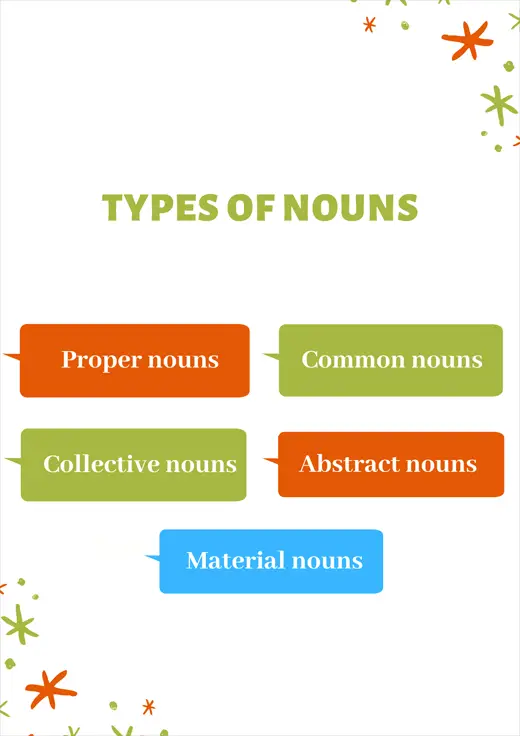
The table shows the eight types. One noun can belong to more than one type. For example, book is a common, concrete and countable noun.
| Type | Definition | Examples |
|---|---|---|
| Common | A general name | City, boy, river |
| Proper | A special name, with a capital letter | Dhaka, Sara, Nile |
| Concrete | Something we can see or touch | Table, apple, rain |
| Abstract | An idea or feeling we cannot touch | Love, honesty, fear |
| Collective | A name for a group | Team, family, class |
| Compound | Two words that make one noun | Toothbrush, mother-in-law |
| Countable | A noun we can count | Pen, chair, student |
| Uncountable | A noun we cannot count | Water, rice, advice |
Common Nouns
A common noun is a general name for a person, place or thing. It starts with a small letter, unless it begins a sentence.
| No. | Sentence |
|---|---|
| 1 | The teacher explained the lesson. |
| 2 | The boy is good at English. |
| 3 | He cannot swim in the river. |
| 4 | The school is closed today. |
| 5 | My father drives a taxi. |
Proper Nouns
A proper noun is the special name of one person, place or thing. It always starts with a capital letter.
| No. | Sentence |
|---|---|
| 6 | Jack is my best friend. |
| 7 | Risa is travelling to Cape Town. |
| 8 | The Nile is a very long river. |
| 9 | Google is a popular search engine. |
| 10 | Asia is the largest continent. |
Concrete Nouns
A concrete noun names something we can see, hear, smell, taste or touch. We know it with our five senses.
| No. | Sentence |
|---|---|
| 11 | The apple is on the table. |
| 12 | I hear the bell. |
| 13 | She wears a blue scarf. |
| 14 | The soup smells good. |
| 15 | Rain fell on the roof. |
Abstract Nouns
An abstract noun names an idea, a feeling or a quality. We cannot see it or touch it.
| No. | Sentence |
|---|---|
| 16 | We have a strong friendship. |
| 17 | Honesty is a great virtue. |
| 18 | Childhood is a happy time. |
| 19 | You cannot explain her beauty in one word. |
| 20 | Never lose your bravery. |
Collective Nouns
A collective noun is a name for a group of people, animals or things. We often use it with a singular verb.
| No. | Sentence |
|---|---|
| 21 | My family lives in Dhaka. |
| 22 | The team plays on Sunday. |
| 23 | The class starts at nine. |
| 24 | A herd of cows crossed the road. |
| 25 | The committee has made a decision. |
Compound Nouns
A compound noun is made of two or more words. It can be one word, two words or a word with a hyphen.
| No. | Sentence |
|---|---|
| 26 | I brush my teeth with a toothbrush. |
| 27 | The classroom is very clean. |
| 28 | My mother-in-law cooks well. |
| 29 | We eat breakfast at seven. |
| 30 | The swimming pool opens at ten. |
Countable Nouns
A countable noun is a noun we can count. It has a singular form and a plural form. We can use a, an or a number with it.
| No. | Sentence |
|---|---|
| 31 | I have two pens. |
| 32 | There is a chair in the room. |
| 33 | Five students are late. |
| 34 | She bought three oranges. |
| 35 | An egg is on the plate. |
Uncountable Nouns
An uncountable noun is a noun we cannot count one by one. It has no plural form. We use words such as some, much and a piece of with it. Material nouns, such as gold, wood and water, belong here.
| No. | Sentence |
|---|---|
| 36 | Please give me some water. |
| 37 | Rice is cheap in this shop. |
| 38 | He gave me good advice. |
| 39 | The bed is made of wood. |
| 40 | We do not have much time. |
Pairs That Students Mix Up
Three pairs of types are easy to mix. The table helps you tell them apart.
| Pair | The difference | Example |
|---|---|---|
| Common and proper | A proper noun is one special name, with a capital letter. | City (common), Paris (proper) |
| Concrete and abstract | We can touch a concrete noun. We cannot touch an abstract noun. | Table (concrete), freedom (abstract) |
| Countable and uncountable | We can count a countable noun. We cannot count an uncountable noun. | Apple (countable), milk (uncountable) |
Check your answer
Common Mistakes
| Common mistake | Better sentence | Why |
|---|---|---|
| I live in dhaka. | I live in Dhaka. | A proper noun needs a capital letter. |
| She gave me many advices. | She gave me much advice. | Advice is uncountable. |
| I need some informations. | I need some information. | Information is uncountable. |
| The team are winning on its ground. | The team is winning on its ground. | Use a singular verb for a team that acts as one. |
| I bought three breads. | I bought three loaves of bread. | Say loaves of bread, because bread is uncountable. |
Practice: Exercises on Types of Nouns
Exercise 1: Find the Type
Write the type of each noun in italics: common, proper, abstract, collective or uncountable.
- Paris is a beautiful city.
- I love music.
- The team is ready.
- She drinks milk.
- The girl is smart.
Show answers for Exercise 1
- Proper noun
- Abstract noun
- Collective noun
- Uncountable noun
- Common noun
Exercise 2: Choose the Correct Word
Choose the correct form.
- I need some (advice / advices).
- She lives in (dhaka / Dhaka).
- He has three (pen / pens).
- We have (a / some) rice.
- The family (is / are) at home.
Show answers for Exercise 2
- Advice (it is uncountable)
- Dhaka (a proper noun needs a capital letter)
- Pens (it is countable and plural)
- Some (rice is uncountable)
- Is (the family acts as one group)
Exercise 3: Correct the Mistake
Each sentence has one mistake. Write the correct sentence.
- I bought many furnitures.
- She is from london.
- He gave me a good informations.
- We drink many waters.
- My sister-in-law are kind.
Show answers for Exercise 3
- I bought much furniture.
- She is from London.
- He gave me good information.
- We drink much water.
- My sister-in-law is kind.
Quiz: Test Yourself
- What does a noun name?
- Which word is a proper noun?
- Which noun is abstract?
- Which noun is collective?
- Which noun is compound?
- Which noun is uncountable?
- Which sentence is correct?
- Which noun is concrete?
- Which sentence is correct?
- Which noun is both common and countable?
Key Takeaways
- A noun names a person, a place, a thing or an idea.
- The 8 types are common, proper, concrete, abstract, collective, compound, countable and uncountable.
- A proper noun always starts with a capital letter.
- We cannot count uncountable nouns, such as water, rice and advice.
- One noun can belong to more than one type.
Frequently Asked Questions
What is a noun?
A noun is a naming word. It names a person, a place, a thing or an idea. For example: teacher, London, phone and love.
What are the types of nouns?
The main types are common, proper, concrete, abstract, collective, compound, countable and uncountable nouns.
What is the difference between common and proper nouns?
A common noun is a general name, such as city. A proper noun is a special name, such as Dhaka, and it always starts with a capital letter.
What is the difference between concrete and abstract nouns?
We can see or touch a concrete noun, such as apple. We cannot see or touch an abstract noun, such as honesty.
What is the difference between countable and uncountable nouns?
We can count countable nouns, such as pens. We cannot count uncountable nouns, such as water, rice and advice.
What is a material noun?
A material noun names a substance that things are made from, such as gold, wood or water. It is usually an uncountable noun.
Related Articles

- Antithesis: Meaning, Examples and the Grammar of Balance - October 17, 2026
- Anaphora: Meaning, Examples and How to Use It - October 17, 2026
- Flashback: Meaning, Examples and How to Write One - October 16, 2026