
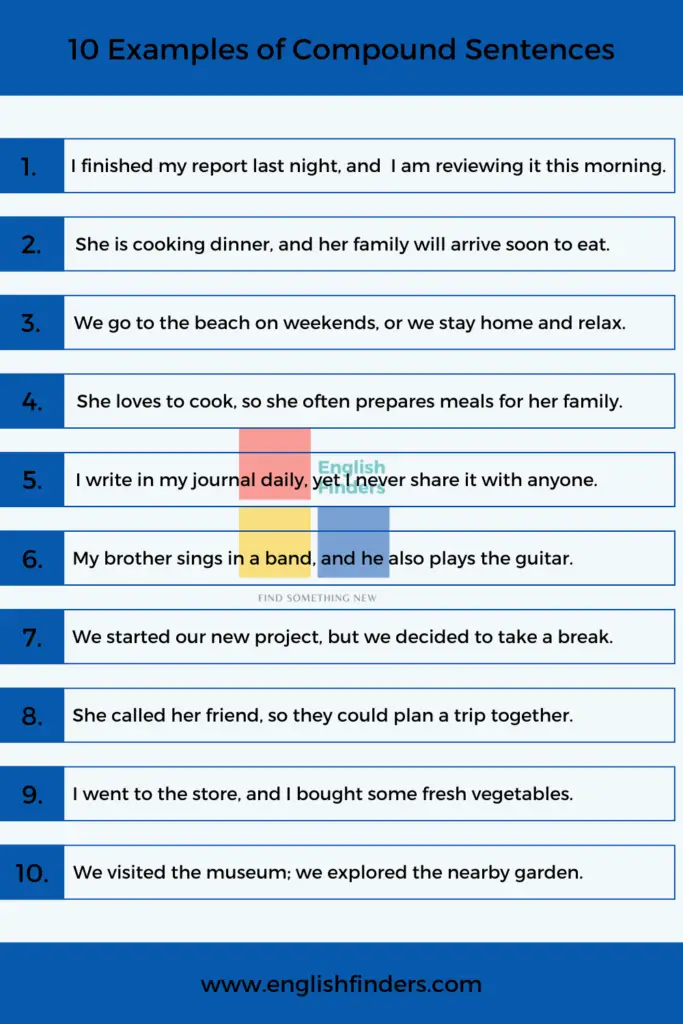
Last updated on November 22nd, 2026 at 08:32 am
Seven short words do most of the joining in English: for, and, nor, but, or, yet and so. Put one of them between two complete sentences, and you get a compound sentence.
It was cold. + We stayed inside. = It was cold, so we stayed inside.
Both halves can still stand alone. That is the key to a compound sentence. This lesson starts with 10 clear examples. Then it shows the rules, more examples by tense, common mistakes and a quiz.
- What a compound sentence is
- 10 clear examples, one for each joining word
- The FANBOYS conjunctions and three ways to join clauses
- Compound sentences in different tenses
- How to tell compound sentences from simple and complex ones
What Is a Compound Sentence?
Quick Navigation
A clause is a group of words with a subject and a verb. An independent clause is a clause that can stand alone as a sentence.
A compound sentence joins two independent clauses. Here is a simple test: cover the joining word. If both parts are still full sentences, the sentence is compound.
- She likes tea + but + her brother likes coffee. Both parts can stand alone, so this is compound.
10 Examples of Compound Sentences
| Example | Joining word | What it shows |
|---|---|---|
| I was hungry, so I made a sandwich. | So | A result |
| She likes tea, but her brother likes coffee. | But | A contrast |
| We can take the bus, or we can walk. | Or | A choice |
| He studies hard, and he helps his classmates. | And | An extra idea |
| He doesn’t eat meat, nor does he drink milk. | Nor | A second negative idea |
| The test was hard, yet everyone passed. | Yet | A surprising contrast |
| She went to bed early, for she was very tired. | For | A reason (formal) |
| It rained all morning; we stayed inside. | Semicolon | Two closely linked ideas |
| I studied all week; however, the test was still hard. | ; however, | A contrast |
| The bus was late; therefore, we missed the film. | ; therefore, | A result |
The FANBOYS Conjunctions
The seven coordinating conjunctions join two equal clauses. The first letters spell FANBOYS.
| Letter | Conjunction | Meaning | Example |
|---|---|---|---|
| F | For | Because (formal) | We stayed home, for it was too cold. |
| A | And | Adds an idea | Sara plays the piano, and Tom plays the violin. |
| N | Nor | Adds a negative idea | I don’t like horror films, nor do I watch them alone. |
| B | But | Shows a contrast | The phone is old, but it still works. |
| O | Or | Gives a choice | Hurry up, or you will miss the bus. |
| Y | Yet | Shows a surprising contrast | He is rich, yet he lives simply. |
| S | So | Shows a result | It was late, so we took a taxi. |
After nor, the verb comes before the subject: nor do I watch, not “nor I watch.”
Three Ways to Join Two Clauses
| Method | Pattern | Example |
|---|---|---|
| Comma + FANBOYS | Clause + , + and/but/so… + clause | He plays football, and his friend reads a novel. |
| Semicolon | Clause + ; + clause | She lives in the USA; her family lives in the UK. |
| Semicolon + linking adverb | Clause + ; + however/therefore + , + clause | He studied hard; however, he failed the exam. |
Compound Sentences in Different Tenses
Present Simple
- I enjoy reading, and my friend enjoys watching movies.
- He studies every day, but he doesn’t always understand the lesson.
- We go to the beach on weekends, or we stay home and relax.
- She loves to cook, so she often makes dinner for her family.
- I write in my diary every day, yet I never show it to anyone.
Past Simple
- I went to the market, and I bought some fresh vegetables.
- He studied all night, but he still didn’t pass the test.
- You took the wrong bus, yet you arrived on time.
- It started to rain, so we went inside.
- He wanted to join the club, but he missed the deadline.
Present Continuous
- I am reading a book, and my sister is watching a movie.
- She is cooking dinner, so we are setting the table.
- You are learning the guitar, but you are still shy about playing in public.
- They are studying for the test, and they are using flashcards.
- It is raining now, yet the children are playing outside.
Present Perfect
- I have finished my homework, and I have cleaned my room.
- She has visited that museum before, but she has never seen the new exhibition.
- They have practiced all week, so they have improved a lot.
- He has worked here for five years, and he has made many friends.
- You have taken many online courses, yet you haven’t finished this one.
Future
- I will call you later, or I will send you a message.
- We will leave early, so we will miss the traffic.
- She will start her new job on Monday, and her brother will drive her there.
- It will be cold tomorrow, so you will need a coat.
- They will visit us in May, but they won’t stay long.
20 Everyday Compound Sentences
- I need to study, or I will fail the test.
- He is a great cook, and he makes dinner every night.
- I want to go to the beach, but it’s too cold.
- I like pizza, but I don’t like pepperoni.
- I went to the store, but it was closed.
- She finished the project on time, and she got a promotion.
- He was running late, so he took a taxi to the airport.
- We went to the shop, but they had no milk.
- He likes to swim, yet he’s afraid of the ocean.
- She wants to travel the world, and he wants to stay at home.
- I’m going to take a nap, or I’m going to watch TV.
- He didn’t understand the homework, so he asked for help.
- She’s a great singer, yet she has never sung in public.
- He wants a new car, but he needs to save more money.
- I need to finish this report, so I will work late tonight.
- She’s allergic to peanuts, so she checks every food label.
- He’s tired from working all day, so he’s going to bed early.
- We’re going to the beach, and we need to pack some sunscreen.
- My aunt is a great host, and she loves having guests.
- She’s a talented artist, yet she has never sold a painting.
Compound or Not?
Some sentences look compound, but they are not. Check for two subjects and two verbs.
| Sentence | Compound? | Why |
|---|---|---|
| I found the key and opened the door. | No | One subject (I) with two verbs. It is a simple sentence. |
| I found the key, and I opened the door. | Yes | Two subjects and two verbs, joined by and. |
| She called her friend so that they could plan a trip. | No | So that shows purpose. It is a complex sentence. |
| She called her friend, so they planned a trip together. | Yes | So shows a result, and both halves are full sentences. |
| It was late, we went home. | No, it is a mistake | A comma alone cannot join two sentences. Add so or use a full stop. |
| Although it was late, but we stayed. | No, it is a mistake | Use although or but, never both. |
Simple, Compound or Complex?
| Type | What it has | Example |
|---|---|---|
| Simple | One independent clause | I stayed home. |
| Compound | Two independent clauses | I was tired, so I stayed home. |
| Complex | One independent clause + one dependent clause | I stayed home because I was tired. |
For more practice, see our 50 examples of compound sentences and 50 examples of complex sentences.
Check your answer
Practice: Join the Sentences
Join each pair with the word in brackets.
- It was cold. We stayed inside. (so)
- I like apples. My sister likes oranges. (but)
- You can call me. You can send an email. (or)
- She studied hard. She passed the exam. (and)
- He was tired. He finished his homework. (yet)
- The shop was closed. We went home. (so)
- I don’t like coffee. I don’t like tea. (nor)
- It rained all day. The match was canceled. (semicolon)
Show answers
- It was cold, so we stayed inside.
- I like apples, but my sister likes oranges.
- You can call me, or you can send an email.
- She studied hard, and she passed the exam.
- He was tired, yet he finished his homework.
- The shop was closed, so we went home.
- I don’t like coffee, nor do I like tea.
- It rained all day; the match was canceled.
Quiz: Test Yourself
- Which sentence is compound?
- What does FANBOYS help you remember?
- “It was raining, ___ we took umbrellas.”
- Choose the correct punctuation.
- “She is rich, ___ she lives in a small apartment.”
- Which joining word shows a choice?
- What is wrong with “It was late, we went home”?
- “I don’t eat meat, nor ___ I eat fish.”
- Which sentence is complex, not compound?
- Where does the comma go? “I like tea and my sister likes coffee.”
Key Takeaways
- A compound sentence joins two independent clauses.
- Use a comma + FANBOYS (for, and, nor, but, or, yet, so) or a semicolon.
- Use a semicolon before however and therefore, and a comma after them.
- One subject with two verbs is a simple sentence, not a compound one.
- A comma alone cannot join two sentences.
Frequently Asked Questions
What is a compound sentence?
A compound sentence has two or more independent clauses. They are joined by a comma and a word like and, but or so, or by a semicolon. Example: I was hungry, so I made a sandwich.
What are 10 examples of compound sentences?
I was hungry, so I ate. She likes tea, but he likes coffee. We can walk, or we can drive. He studies, and he works. I don’t smoke, nor do I drink. It was hard, yet we passed. She left, for she was tired. It rained; we stayed in. I tried; however, I failed. The bus was late; therefore, we missed it.
What are the FANBOYS?
FANBOYS is a way to remember the seven coordinating conjunctions: for, and, nor, but, or, yet and so. They join two equal clauses in a compound sentence.
Do you need a comma in a compound sentence?
Usually, yes. Put a comma before and, but or so when both clauses have their own subject: I like tea, and my sister likes coffee. With a semicolon, you do not need a joining word.
What is the difference between compound and complex sentences?
A compound sentence joins two independent clauses with and, but or so. A complex sentence joins an independent clause with a dependent clause, using a word like because, when or although.
What is a compound-complex sentence?
It has at least two independent clauses and at least one dependent clause. Example: I called her when I got home, but she was asleep.
Related Articles

- Lay vs Lie: The Difference, Verb Forms and Examples - November 24, 2026
- Farther vs Further: Distance, Degree and Useful Phrases - November 24, 2026
- Compliment vs Complement: Meaning, Spelling and Examples - November 24, 2026