
Last updated on November 21st, 2026 at 07:10 pm
Here are two short sentences: It was raining. We stayed inside. Now join them with because: We stayed inside because it was raining. The second part cannot stand alone anymore. It depends on the first part, and that makes the sentence complex.
This page explains what a complex sentence is and how to build one. It gives 50 examples grouped by the type of clause, shows where the comma goes, and ends with practice and a quiz.
- What independent and dependent clauses are
- The words that start a dependent clause
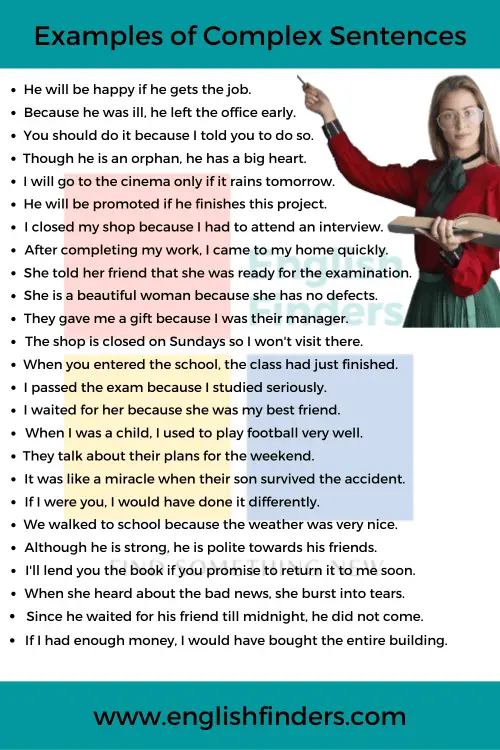
- 50 complex sentences, grouped by clause type
- Where to put the comma
- How to tell complex sentences from compound and simple ones
What Is a Complex Sentence?
Quick Navigation
A clause is a group of words with a subject and a verb. An independent clause makes sense on its own. A dependent clause does not, because it starts with a linking word like because or when.
| Clause | Example | Can it stand alone? |
|---|---|---|
| Independent | We stayed inside. | Yes |
| Dependent | Because it was raining | No |
| Complex sentence | We stayed inside because it was raining. | Yes, it is a full sentence |
A complex sentence joins the two. The dependent clause adds information about time, reason, condition, contrast or purpose. It can also describe a noun or act as a noun.
Words That Start a Dependent Clause
These words are called subordinating conjunctions and relative pronouns. They tell the reader how the two ideas connect.
| Meaning | Linking words |
|---|---|
| Time | When, while, before, after, since, until, as soon as, whenever |
| Reason | Because, since, as, now that |
| Condition | If, unless, as long as, in case |
| Contrast | Although, though, even though, whereas, while |
| Purpose or result | So that, so… that, such… that |
| Describing a noun | Who, whom, whose, which, that, where, when |
| Acting as a noun | That, what, whoever, where, why, how, whether |
50 Examples of Complex Sentences
In each example, the dependent clause is in bold.
Time Clauses
Pattern: when / while / before / after / until + subject + verb.
- When the bell rang, the students left the classroom.
- I will call you after I finish work.
- While my mother was cooking, my father set the table.
- Before you leave, please turn off the lights.
- She has lived in Dhaka since she was a child.
- As soon as the rain stopped, we went outside.
- We waited at the stop until the bus arrived.
- Whenever I visit my grandparents, they cook my favorite food.
Reason Clauses
Pattern: because / since / as + subject + verb.
- He left the office early because he felt ill.
- Since you have finished your homework, you can take a break.
- As it was getting dark, we decided to go home.
- She couldn’t come to the party because she was sick.
- Because the road was closed, we took a different route.
- I passed the exam because I studied every day.
- We walked to school because the weather was nice.
- Now that you are here, we can start the meeting.
Condition Clauses
Pattern: if / unless / as long as + subject + verb.
- If it rains tomorrow, we will stay at home.
- He will get the job if he does well in the interview.
- Unless you study harder, you will not pass the exam.
- If I had more money, I would buy a new laptop.
- If I were you, I would apologize to her.
- He would have passed if he had listened to his teacher.
- I will lend you the book as long as you return it next week.
- Take a jacket in case it gets cold.
Contrast Clauses
Pattern: although / though / even though / whereas + subject + verb.
- Although it was raining heavily, he arrived at the office on time.
- Though I had little money, I bought my mother a gift.
- Even though she was tired, she finished her homework.
- Although he is very strong, he is gentle with his friends.
- Whereas my brother loves football, I prefer cricket.
- While some people enjoy city life, others prefer the countryside.
- Although he worked hard on the painting, it did not win a prize.
Purpose and Result Clauses
Pattern: so that + subject + can / could / will, or so + adjective + that.
- The teacher explained the lesson again so that everyone could understand.
- She saved money so that she could travel to Japan.
- We left early so that we would not miss the train.
- He spoke so quietly that nobody could hear him.
- It was such a good film that we watched it twice.
Relative (Adjective) Clauses
Pattern: noun + who / whose / which / that / where + clause.
- The man who lives next door is a doctor.
- I have a friend whose father is a pilot.
- The book that you gave me is very interesting.
- This is the house where I was born.
- She is the teacher whom everyone respects.
- My phone, which I bought last year, still works well.
- I still remember the day when we first met.
- Students who practice every day improve quickly.
Noun Clauses
Pattern: that / what / where / why / whoever + clause, used as a subject or an object.
- I know that you are telling the truth.
- She told her friend that she was ready for the exam.
- What he said surprised everyone.
- I don’t know where she lives.
- Can you tell me why the shop is closed?
- Whoever finishes first will win a prize.
Where Does the Comma Go?
| Clause order | Comma? | Example |
|---|---|---|
| Dependent clause first | Yes | Because it rained, we stayed inside. |
| Main clause first | Usually no | We stayed inside because it rained. |
| Extra information about a noun | Yes, before and after | My phone, which is old, still works. |
| Information you need to identify the noun | No | The phone that I bought yesterday is new. |
Complex, Compound or Simple?
Learners often mix these up. Look at the linking word and check for a subject and a verb.
| Sentence | Type | Why |
|---|---|---|
| After I finished my work, I went home. | Complex | After starts a clause with a subject (I) and a verb (finished). |
| After finishing my work, I went home. | Simple | After finishing my work has no subject, so it is a phrase, not a clause. |
| The shop is closed, so I will come back tomorrow. | Compound | So joins two independent clauses as equals. |
| The shop is closed because it is Sunday. | Complex | Because makes the second clause depend on the first. |
You can read more in our full guide to complex sentences.
Check your answer
Practice: Complete the Complex Sentences
Choose a linking word for each blank: after, because, before, if, although, once, as, since.
- I will go to the party ______ I finish my work.
- She cannot attend the meeting ______ she has a doctor’s appointment.
- They decided to stay home ______ it was raining outside.
- We should take a break ______ we complete this task.
- ______ you study harder, you will improve your grades.
- She went to the library ______ she needed books for her project.
- ______ the movie started, they bought some popcorn.
- He couldn’t find his keys, ______ they were in his jacket pocket.
- ______ the traffic clears, we will be able to leave.
- ______ I finish my presentation, I will join you for lunch.
Show answers
- After (or when)
- Because
- Because (or as)
- After (or once)
- If
- Because (or since)
- Before
- Although (the keys were close, but he still couldn’t find them)
- Once (or After)
- After (or Once)
Quiz: Test Yourself
- Which sentence is complex?
- Which word starts a dependent clause?
- When the dependent clause comes first, where does the comma go?
- “___ it was cold, she didn’t wear a coat.”
- “The man ___ car was stolen called the police.”
- Is this sentence complex? “After finishing lunch, we went for a walk.”
- Which sentence is correct?
- “I will call you ___ I arrive.”
- In “I know that you are right,” what is “that you are right”?
- “You will miss the bus ___ you hurry.”
Key Takeaways
- A complex sentence has one independent clause and at least one dependent clause.
- A dependent clause starts with a word like because, when, if, although, who or that.
- Put a comma after the dependent clause when it comes first.
- And, but and so make compound sentences, not complex ones.
- Never use although and but together.
Frequently Asked Questions
What is a complex sentence?
A complex sentence has one independent clause and at least one dependent clause. Example: We stayed inside because it was raining.
What are 10 examples of complex sentences?
When the bell rang, we left. I passed because I studied. If it rains, we will stay home. Although she was tired, she worked. The man who lives next door is a doctor. I know that you are right. She saved so that she could travel. Whoever wins gets a prize. I don’t know where she lives. As soon as it stopped, we went out.
How do you identify a complex sentence?
Look for a clause that starts with a word like because, when, if, although, who or that, and check that it has its own subject and verb. If that clause cannot stand alone, the sentence is complex.
What is the difference between compound and complex sentences?
A compound sentence joins two equal independent clauses with and, but or so. A complex sentence joins an independent clause with a dependent clause, using a word like because or although.
Does a complex sentence need a comma?
Use a comma when the dependent clause comes first: Because it rained, we stayed inside. When the main clause comes first, you usually do not need one: We stayed inside because it rained.
What is a compound-complex sentence?
It has at least two independent clauses and at least one dependent clause. Example: I called her when I got home, but she was asleep.
Related Articles

- Who vs Whom: The Simple Test and When Whom Still Matters - November 22, 2026
- Advice vs Advise: Noun or Verb, Sound and Examples - November 22, 2026
- Oxford Comma: What It Is, Examples and When to Use It - November 21, 2026