
Last updated on September 4th, 2026 at 02:48 pm
There are many types of sentences in English grammar, and the interrogative sentence is one of them. Interrogative sentences deal with questions, and we use them whenever we ask someone something.
In other words, questions and interrogative sentences are closely connected. Now let’s look at the definition of this sentence type.
What Is an Interrogative Sentence?
Quick Navigation
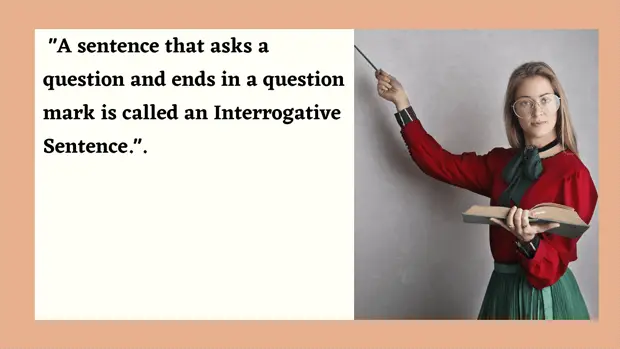
A sentence that asks a question and ends in a question mark (?) is called an interrogative sentence. It is used to ask questions or request information.
Unlike assertive sentences, which make statements, interrogative sentences seek information from the listener or reader. Let’s look at some examples.
- Do you love me?
- Will you help the poor boy?
- What is your favorite food?
- Have they played today?
- Did we follow the commandment?
Note: All the sentences ask questions and end in questions mark.
Let us see the affirmative and negative forms:
| Affirmative | Negative |
| Will you help me? | Will you not help me? |
| Does he take his dinner? | Does he not take his dinner? |
| Did she know you? | Did she not know you? |
| Have you read the book? | Have you not read the book? |
| Can you lend me some money? | Can you not lend me some money? |
Structure: Auxiliary Verb+ Subject+ Main Verb+ Object
Major Characteristics of Interrogative Sentences
Two key characteristics that differentiate interrogative sentences are:
- Question Mark: Interrogative sentences always end with a question mark (?) to indicate that a question is being asked.
- Inversion of Subject and Verb: In most cases, interrogative sentences involve the inversion of the subject and the auxiliary verb. For example, in the sentence “Are you coming?”, the subject “you” follows the auxiliary verb “are.”
Types of Interrogative Sentences
There are several types of interrogative sentences, each serving a specific purpose:
Yes/No Questions
These questions are designed to receive a simple “yes” or “no” answer. They typically start with an auxiliary verb (is, are, do, does, etc.). Let’s see some examples:
- Do you like coffee?
- Are you happy to see your friend?
- Did you enjoy the cricket match?
- Have we been there before?
- Does he accept your friend request?
Wh- Questions
These questions start with question words like who, what, where, when, why, and how. They are used to gather specific information. Let’s see some examples:
- What time does the meeting start?
- Where are you from?
- When did he leave the place?
- Why do you take too much time to answer this question?
- How does time fly so rapidly?
Alternative Questions
These questions offer two or more possible answers, usually connected by “or.” Let’s see some examples:
- Would you like tea or coffee?
- May I leave or wait?
- Have you stayed here or gone to your home?
- Will you speak or keep silent?
- Can you give me the book or pen?
Tag Questions
Tag questions are short questions added to the end of a declarative sentence to confirm information. Let’s see some examples:
- You’re coming to the party, aren’t you?
- He is your brother, doesn’t he?
- We are good friends, aren’t we?
- They have watched the movie, haven’t they?
- She saw a beautiful bird yesterday, didn’t she?
Rhetorical Questions
A rhetorical question is asked for effect, not to get an actual answer — the speaker already knows (or doesn’t expect) a reply. It’s still an interrogative sentence grammatically, but its purpose is persuasive or emphatic rather than informational. Let’s see some examples:
- Isn’t it obvious what we should do?
- Who doesn’t love a good meal?
- How many times do I have to tell you?
- Why me?
- Can’t you see I’m busy?
Direct vs. Indirect Questions
Not every sentence that mentions a question is itself an interrogative sentence. A direct question is asked outright and ends with a question mark — it’s a true interrogative sentence.
An indirect question is embedded inside a statement (often starting with phrases like “I wonder,” “She asked,” or “Could you tell me”) and is punctuated as a declarative sentence, ending with a period, not a question mark.
| Direct Question (Interrogative) | Indirect Question (Declarative) |
|---|---|
| Where do you live? | She asked me where I lived. |
| What time is it? | I wonder what time it is. |
| Can you help me? | Could you tell me if you can help me. |
Note: Even though an indirect question is “about” a question, it is not an interrogative sentence — grammatically it’s declarative, so it ends with a period.
Examples of Interrogative Sentences
Let us see some examples below so that we can quickly identify this type of Sentence:

- Do you take your lunch?
- Who is your favorite poet?
- What is his ambition for the future?
- Can you follow the procedure properly?
- Don’t I see you before?
- Have you seen the place?
- Did she accept your request?
- When do you take off from the airport?
- Whom does she accept as a life partner?
- Will they participate in the program?
- Is he trying to do it?
- Does she not take part in the debate competition?
- Did Kareem not play badminton?
- Could you not remember the incident?
- May he come here tonight?
- Does Saniya know you?
- What is your favorite movie?
- Am I looking at you?
- Whom do you choose for the game?
- Can we donate some money to poor people?
Common Mistakes to Avoid
- Forgetting subject-verb inversion. “You are coming?” is informal speech; the standard interrogative form inverts to “Are you coming?”
- Punctuating an indirect question with a question mark. “I wonder where he went?” should end with a period: “I wonder where he went.”
- Missing the question mark entirely. Even a short question like “Really” needs its question mark: “Really?”
- Mixing up tag question polarity. A positive statement takes a negative tag (“You’re coming, aren’t you?”), and a negative statement takes a positive tag (“You aren’t coming, are you?”).
Frequently Asked Questions
What is an interrogative sentence?
An interrogative sentence is a sentence that asks a question and ends with a question mark, used to request information from the listener or reader.
What are the main types of interrogative sentences?
The main types are yes/no questions, wh- questions, alternative questions, tag questions, and rhetorical questions (asked for effect rather than to get an answer).
Is an indirect question an interrogative sentence?
No. An indirect question is embedded inside a statement (for example, “I wonder where he went.”) and is punctuated as a declarative sentence with a period, not a question mark.
How do you punctuate a tag question?
A tag question adds a short question to the end of a statement, separated by a comma, and the whole sentence ends with a question mark: “You like tea, don’t you?”
Continue Learning
Interrogative Sentences Quiz


- Antithesis: Meaning, Examples and the Grammar of Balance - October 17, 2026
- Anaphora: Meaning, Examples and How to Use It - October 17, 2026
- Flashback: Meaning, Examples and How to Write One - October 16, 2026
Thank you for your online through