
Last updated on October 14th, 2026 at 04:08 pm
Read these two sentences: The sun rises in the east. and Where does the sun rise? The first one gives information. The second one asks for it.
The first one is an assertive sentence. It states a fact, an opinion or a feeling, and it ends with a full stop.
This lesson explains what an assertive sentence is, shows its structure, and gives 30 examples. You will also learn how to change it into other sentence types, and then practice with exercises, a quiz and a FAQ.
- What an assertive sentence is, and why it is also called a declarative sentence
- The structure of affirmative and negative assertive sentences
- How it is different from questions, commands and exclamations
- 30 simple examples in groups
- How to change an assertive sentence into other types
What Is an Assertive Sentence?
Quick Navigation
An assertive sentence is a sentence that makes a statement. It tells the reader something: a fact, an idea, a feeling or a plan. Most sentences that we say and write every day are assertive.
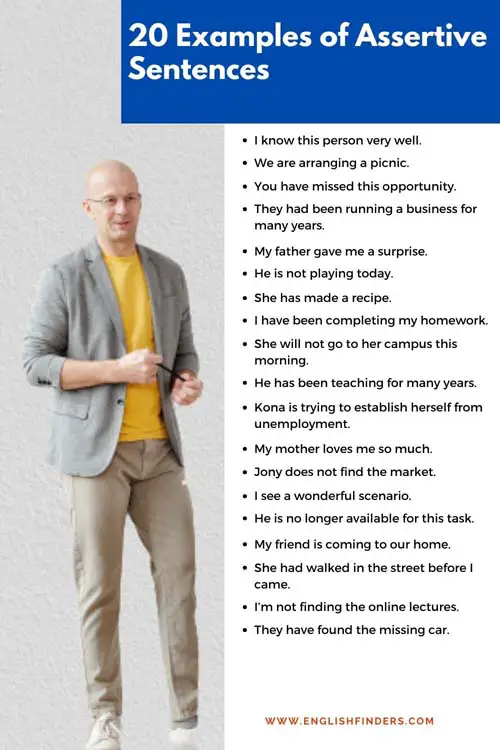
Here are three simple examples:
- Water is important for life.
- I like green tea.
- We will visit our grandmother on Friday.
Assertive sentences are also called declarative sentences. Both names mean the same thing. You can read more in our guide to declarative sentences.
A simple test helps you find them. A statement can be true or false. A question or a command cannot.
Structure of an Assertive Sentence
The basic order is: subject + verb + the rest of the sentence. The subject comes first, and the verb comes next. Then we add an object, a place, a time or other details.
| Subject | Verb | The rest |
|---|---|---|
| She | Reads | A story every night. |
| The children | Are playing | In the garden. |
| My father | Works | In a bank. |
An assertive sentence can be affirmative or negative. An affirmative sentence says that something is true. A negative sentence says that something is not true, and it uses not.
| Affirmative | Negative |
|---|---|
| I need a good friend. | I do not need a good friend. |
| He is singing a song. | He is not singing a song. |
| She has bought a dress. | She has not bought a dress. |
| They were late. | They were not late. |
| You look happy today. | You do not look happy today. |
Every assertive sentence starts with a capital letter and ends with a full stop.
Assertive Sentence vs Other Sentence Types
English has four main types of sentences. The assertive sentence is the one we use most. The table shows how the four types are different.
| Type | Job | Example | Ends with |
|---|---|---|---|
| Assertive | States something | The shop opens at nine. | Full stop |
| Interrogative | Asks a question | Does the shop open at nine? | Question mark |
| Imperative | Gives a command or request | Open the shop at nine. | Full stop or exclamation mark |
| Exclamatory | Shows strong feeling | What a big shop it is! | Exclamation mark |
You can study the other types in our guides to interrogative sentences, imperative sentences and types of sentences.
Check your answer
Assertive Sentence or Assertive Communication?
Some websites mix up two ideas. An assertive sentence is a grammar term. Assertive communication is a way of speaking: you say what you need in a clear and polite way. They are not the same thing. This lesson is about the grammar term.
30 Examples of Assertive Sentences
The examples are in five groups. Read each sentence aloud.
Facts
| No. | Sentence |
|---|---|
| 1 | The Earth moves around the sun. |
| 2 | Water boils at 100 degrees Celsius. |
| 3 | Dhaka is the capital of Bangladesh. |
| 4 | A week has seven days. |
| 5 | Birds have wings. |
| 6 | The moon shines at night. |
| 7 | Ice melts in the sun. |
| 8 | Rice grows in warm places. |
Habits and Routines
| No. | Sentence |
|---|---|
| 9 | I wake up at six every day. |
| 10 | My father reads the news after breakfast. |
| 11 | She walks to school with her friend. |
| 12 | We eat dinner at eight. |
| 13 | The bus comes at seven. |
| 14 | He drinks tea every morning. |
Opinions and Feelings
| No. | Sentence |
|---|---|
| 15 | I think this book is very good. |
| 16 | She feels happy today. |
| 17 | My brother loves cricket. |
| 18 | The soup tastes delicious. |
| 19 | I believe honesty is important. |
| 20 | They are proud of their team. |
Negative Sentences
| No. | Sentence |
|---|---|
| 21 | I do not like loud music. |
| 22 | He is not at home. |
| 23 | She does not drink coffee. |
| 24 | We have not finished the work. |
| 25 | The shop is not open today. |
Past and Future Sentences
| No. | Sentence |
|---|---|
| 26 | I visited my aunt last week. |
| 27 | They watched a film yesterday. |
| 28 | She will call you tonight. |
| 29 | We will travel by train next month. |
| 30 | The class will start at nine tomorrow. |
How to Change an Assertive Sentence
You can change an assertive sentence into another type. The meaning changes a little, but the main idea stays the same.
| Assertive | Interrogative | Imperative | Exclamatory |
|---|---|---|---|
| The weather is nice. | Is the weather nice? | Enjoy the nice weather. | What nice weather it is! |
| You sing well. | Do you sing well? | Sing well. | How well you sing! |
| The soup is hot. | Is the soup hot? | Be careful with the hot soup. | How hot the soup is! |
For a question, we move the helping verb to the front or add do or does. For a command, we remove the subject and use the base verb. For an exclamation, we start with what or how and end with an exclamation mark.
Common Mistakes
| Common idea | Better statement | Why |
|---|---|---|
| An assertive sentence ends with a question mark. | It ends with a full stop. | A question mark belongs to an interrogative sentence. |
| Assertive sentences are always positive. | They can be positive or negative. | I do not like tea is also assertive. |
| She do not like tea. | She does not like tea. | Use does not with he, she and it. |
| Assertive sentences only state facts. | They also state opinions, feelings and plans. | I think it is a good plan is assertive. |
| An assertive sentence means a rude sentence. | It only means a statement. | The word is a grammar term, not a tone of voice. |
Practice: Exercises on Assertive Sentences
Exercise 1: Is It Assertive?
Write assertive or not assertive for each sentence.
- The sun rises in the east.
- Where do you live?
- Close your book.
- What a lovely day it is!
- My sister does not eat fish.
- Do you like tea?
Show answers for Exercise 1
- Assertive (a fact)
- Not assertive (a where question)
- Not assertive (it is a command)
- Not assertive (it is an exclamation)
- Assertive (a negative statement)
- Not assertive (a yes or no question)
Exercise 2: Make the Sentences Negative
Change each sentence into a negative assertive sentence.
- I like coffee.
- She is a doctor.
- They play football.
- He has a car.
- We were late.
Show answers for Exercise 2
- I do not like coffee.
- She is not a doctor.
- They do not play football.
- He does not have a car.
- We were not late.
Exercise 3: Name the Sentence Type
Write assertive, interrogative, imperative or exclamatory.
- Open the door.
- She reads a book every day.
- How tall he is!
- Are you ready?
- Water boils at 100 degrees Celsius.
- Please sit down.
Show answers for Exercise 3
- Imperative (a command)
- Assertive (a habit)
- Exclamatory
- Interrogative
- Assertive (a fact)
- Imperative (a polite request)
Quiz: Test Yourself
- What is an assertive sentence?
- Which sentence is assertive?
- What is another name for an assertive sentence?
- Which punctuation mark usually ends an assertive sentence?
- What is the negative form of She likes tea?
- Which sentence is not assertive?
- Can an assertive sentence be negative?
- Which sentence is the question form of You speak English?
- Which sentence states an opinion?
- What does assertive communication mean?
Key Takeaways
- An assertive sentence states a fact, an opinion, a feeling or a plan.
- It is also called a declarative sentence.
- The basic order is subject + verb + the rest of the sentence.
- It can be affirmative or negative, and it ends with a full stop.
- It is different from a question, a command and an exclamation.
Frequently Asked Questions
What is an assertive sentence?
An assertive sentence states a fact, an opinion, a feeling or a plan. For example: The shop opens at nine.
Is an assertive sentence the same as a declarative sentence?
Yes. Assertive and declarative are two names for the same sentence type. Both make a statement.
Which punctuation mark ends an assertive sentence?
A full stop ends most assertive sentences. A question mark belongs to a question, and an exclamation mark belongs to an exclamation.
Can an assertive sentence be negative?
Yes. It can be affirmative or negative. For example: She does not drink coffee.
How do you change an assertive sentence into a question?
Move the helping verb to the front, or add do or does. For example: You sing well becomes Do you sing well?
What is the difference between an assertive sentence and assertive communication?
An assertive sentence is a grammar term for a statement. Assertive communication is a way of speaking clearly and politely about what you need.
Related Articles

- Figures of Speech: Meaning, Types and Examples - October 19, 2026
- Chiasmus: Meaning, Examples and How to Build One - October 19, 2026
- Antithesis: Meaning, Examples and the Grammar of Balance - October 17, 2026