
Last updated on October 17th, 2026 at 11:10 am
I have lost my keys. This sentence tells us about the past, but it is also about now. The keys are lost, and I cannot open the door at this moment.
That is the present perfect tense. We use it to connect a past action with the present. It does not say exactly when the action happened. It says that the action matters now.
This lesson explains the formula and the main uses of the present perfect. It gives 50 example sentences, then exercises, a quiz and a FAQ.
- The formula, with negative and question forms
- Five common uses of the present perfect
- Time words such as already, yet, for and since
- 50 example sentences in five groups
- The difference between the present perfect and the past simple
- How to avoid common mistakes, with exercises and a quiz
Structure of the Present Perfect
Quick Navigation
We use have with I, you, we and they. We use has with he, she and it. Then we add the past participle of the main verb.
| Form | Structure | Example |
|---|---|---|
| Positive | Subject + have/has + past participle | They have arrived. |
| Negative | Subject + have/has not + past participle | They haven’t arrived. |
| Question | Have/Has + subject + past participle? | Have they arrived? |
| Short answer | Yes, subject + have/has. / No, subject + haven’t/hasn’t. | Yes, they have. |
Regular verbs end in -ed in the past participle, such as worked and finished. Irregular verbs have special forms, such as gone, seen, eaten and written.
Uses of the Present Perfect
There are five main uses.
| Use | Example |
|---|---|
| Life experience | I have visited Japan. |
| A recent action with a result now | She has broken her arm. |
| An action that started in the past and continues now | We have lived here for ten years. |
| A change over time | The city has grown a lot. |
| A very recent event | He has just left. |
Check your answer
Time Words for the Present Perfect
Some words often go with the present perfect. They show that the time is not finished or not named.
| Word | Meaning | Example |
|---|---|---|
| Ever | At any time in your life | Have you ever been to Paris? |
| Never | At no time in your life | I have never met him. |
| Already | Sooner than expected | She has already left. |
| Yet | Until now, in questions and negatives | I haven’t finished yet. |
| Just | A very short time ago | We have just arrived. |
| So far | Until now | I have read three books so far. |
| For | A length of time | He has worked here for five years. |
| Since | From a point in time | She has lived here since 2018. |
| Recently | Not long ago | They have recently moved. |
50 Examples of the Present Perfect
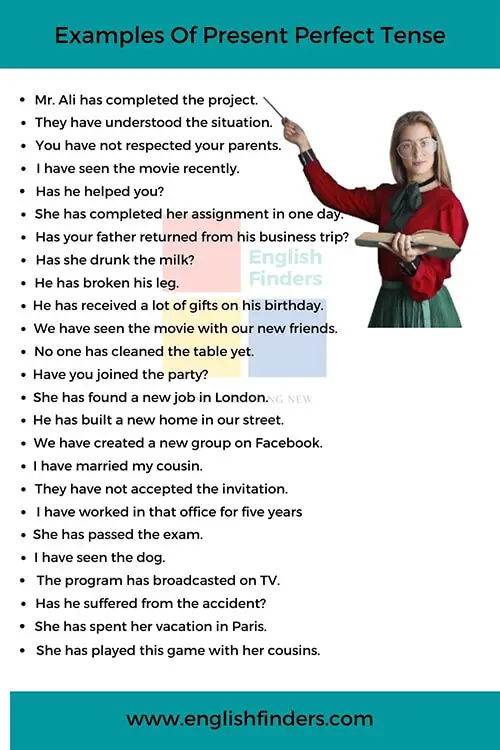
The sentences are in five groups. Each group shows one use or form.
Life Experience
| No. | Sentence |
|---|---|
| 1 | I have visited three different cities in my life. |
| 2 | She has met a famous singer. |
| 3 | We have eaten Thai food many times. |
| 4 | He has never flown in a plane. |
| 5 | They have climbed a high mountain. |
| 6 | Have you ever tried horse riding? |
| 7 | My brother has read all the Harry Potter books. |
| 8 | I have seen that film twice. |
| 9 | She has driven a truck. |
| 10 | We have swum in the sea at night. |
Recent Actions and Results
| No. | Sentence |
|---|---|
| 11 | Mr. Ali has finished the project. |
| 12 | The kids have washed their hands. |
| 13 | He has broken his leg. |
| 14 | She has found a new job in London. |
| 15 | We have cleaned the house for our guests. |
| 16 | I have just sent the email. |
| 17 | They have already eaten lunch. |
| 18 | My father has returned from his business trip. |
| 19 | The bus has just left. |
| 20 | I have lost my wallet. |
For, Since and So Far
| No. | Sentence |
|---|---|
| 21 | I have worked in this office for five years. |
| 22 | She has studied English since 2019. |
| 23 | We have lived in this street for a long time. |
| 24 | He has played the guitar since he was ten. |
| 25 | They have been friends for twenty years. |
| 26 | It has rained all week. |
| 27 | I have known her since school. |
| 28 | The shop has been closed since Monday. |
| 29 | We have waited here for an hour. |
| 30 | I have read five pages so far. |
Changes and Achievements
| No. | Sentence |
|---|---|
| 31 | She has passed the exam. |
| 32 | He has built a new house on our street. |
| 33 | We have created a study group on WhatsApp. |
| 34 | The city has grown very fast. |
| 35 | Prices have gone up this year. |
| 36 | My English has improved a lot. |
| 37 | The company has opened ten new shops. |
| 38 | Our team has won the cup. |
| 39 | She has become a doctor. |
| 40 | The weather has changed a lot. |
Negatives and Questions
| No. | Sentence |
|---|---|
| 41 | They have not understood the situation. |
| 42 | You have not remembered your promise. |
| 43 | I haven’t finished my homework yet. |
| 44 | She hasn’t called me today. |
| 45 | We haven’t seen him for a week. |
| 46 | Has your father returned from work? |
| 47 | Have you eaten breakfast yet? |
| 48 | Has she drunk her milk? |
| 49 | How long have you lived here? |
| 50 | What have you done with my pen? |
Present Perfect and Past Simple
Both tenses talk about the past, but they are not the same. The past simple names a finished time. The present perfect connects the past with now.
| Tense | Use | Example |
|---|---|---|
| Past simple | A finished time | I lost my keys yesterday. |
| Present perfect | A result now | I have lost my keys. |
| Past simple | A finished period | She lived in Paris in 2015. |
| Present perfect | A period up to now | She has lived in Paris for five years. |
Check your answer
Common Mistakes
| Common mistake | Better sentence | Why |
|---|---|---|
| I have seen him yesterday. | I saw him yesterday. | Use the past simple with a finished time. |
| She has went home. | She has gone home. | Use the past participle, not the past simple. |
| He has lived here since five years. | He has lived here for five years. | Use for with a length of time. |
| I have finished my homework already yesterday. | I finished my homework yesterday. | Do not use the present perfect with yesterday. |
| Did you ever see a ghost? | Have you ever seen a ghost? | Use the present perfect to ask about life experience. |
Practice: Exercises on the Present Perfect
Exercise 1: Complete the Sentences
Write the verb in the present perfect tense.
- She (finish) her homework.
- They (not arrive) yet.
- I (see) that film twice.
- He (live) here for ten years.
- (You / ever / eat) sushi?
Show answers for Exercise 1
- Has finished
- Have not arrived
- Have seen
- Has lived
- Have you ever eaten
Exercise 2: Choose the Correct Word
Choose the best form.
- I (lost / have lost) my phone, so I cannot call you.
- She (went / has gone) to Paris last year.
- We have lived here (for / since) 2015.
- They have waited (for / since) two hours.
- He (has visited / visited) Japan in 2019.
Show answers for Exercise 2
- Have lost (the result is true now)
- Went (last year is a finished time)
- Since (2015 is a starting point)
- For (two hours is a length of time)
- Visited (2019 is a finished time)
Exercise 3: Correct the Mistake
Each sentence has one mistake. Write the correct sentence.
- I have seen him yesterday.
- She has went to school.
- He has lived here since ten years.
- Did you ever visit Japan?
- They have not came yet.
Show answers for Exercise 3
- I saw him yesterday.
- She has gone to school.
- He has lived here for ten years.
- Have you ever visited Japan?
- They have not come yet.
Quiz: Test Yourself
- What is the formula of the present perfect?
- Which sentence is in the present perfect?
- Which auxiliary goes with she?
- Which sentence is correct?
- Which word shows a length of time?
- Which word shows a starting point?
- Which is the past participle of go?
- Which sentence is a correct question?
- What does the present perfect often show?
- Which sentence is correct?
Key Takeaways
- Form the present perfect with have/has + past participle.
- Use it for life experience, recent results, unfinished time and changes.
- Do not use it with a finished time, such as yesterday.
- Use for with a length of time and since with a starting point.
- Common time words are ever, never, already, yet and just.
Frequently Asked Questions
What is the present perfect tense?
The present perfect links the past with the present. It uses have or has and the past participle. For example: She has finished her homework.
How do we form the present perfect?
Use have with I, you, we and they, and has with he, she and it. Then add the past participle. For example: They have arrived.
When do we use the present perfect?
Use it for life experience, recent actions with a result now, unfinished time with for and since, changes over time and very recent events.
What is the difference between the present perfect and the past simple?
The past simple names a finished time: I saw him yesterday. The present perfect connects the past with now: I have seen him.
When do we use for and since?
Use for with a length of time, such as five years. Use since with a starting point, such as 2019.
Can we use the present perfect with yesterday?
No. Yesterday is a finished time, so use the past simple. Say I saw him yesterday. Do not say I have seen him yesterday.
Related Articles

- Figures of Speech: Meaning, Types and Examples - October 19, 2026
- Chiasmus: Meaning, Examples and How to Build One - October 19, 2026
- Antithesis: Meaning, Examples and the Grammar of Balance - October 17, 2026