
Last updated on October 15th, 2026 at 08:04 am
Birds sing. I like tea. The bus is late. Each of these sentences has one complete idea and nothing more. They are simple sentences.
A simple sentence has one main clause. It can be very short or fairly long, but it never has a second clause. We use simple sentences every day to speak clearly.
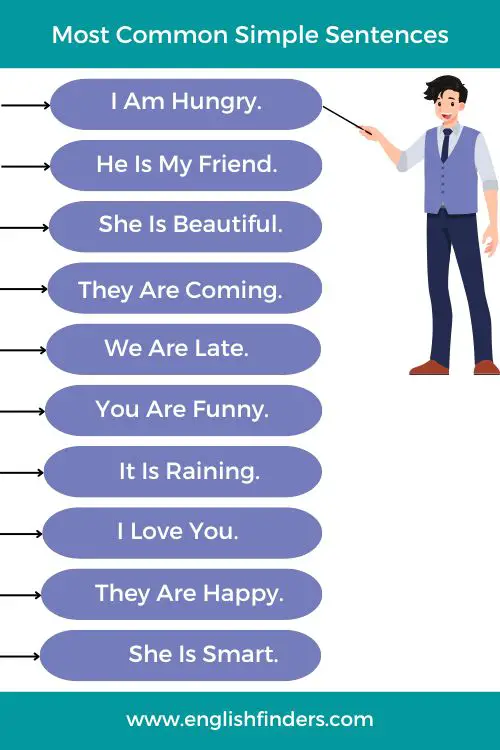
This lesson gives the most common simple sentences in English, grouped by pattern. It also explains how to spot them and ends with exercises, a quiz and a FAQ.
- What a simple sentence is, and what it is not
- The four common patterns of simple sentences
- 20 common simple sentences, five in each pattern
- How a simple sentence differs from a compound or complex sentence
- How to avoid common mistakes, with exercises and a quiz
What Is a Simple Sentence?
Quick Navigation
A simple sentence is a sentence with only one main clause. A clause is a group of words with a subject and a verb. A main clause makes complete sense on its own.
A simple sentence has no dependent clause. A dependent clause starts with a word such as because or although, and it cannot stand alone.
A simple sentence can still be long. It may have more than one subject or more than one verb, but it has only one clause. Tom and Sara sing and dance. is a simple sentence.
You can read more in our guide to the simple sentence.
Patterns of Simple Sentences
Most simple sentences follow one of four patterns. The letters mean subject (S), verb (V), object (O), complement (C) and adverbial (A).
| Pattern | What it means | Example |
|---|---|---|
| S + V | A subject and a verb | Birds sing. |
| S + V + O | A subject, a verb and an object | I like tea. |
| S + V + C | A subject, a linking verb and a complement | She is a teacher. |
| S + V + A | A subject, a verb and a time or place | We live in Dhaka. |
An object receives the action. A complement describes the subject. An adverbial tells us where, when or how.
20 Most Common Simple Sentences
The sentences are in four groups. Each group shows one pattern.
Subject + Verb
| No. | Sentence | What it shows |
|---|---|---|
| 1 | Birds sing. | An action with no object |
| 2 | The baby sleeps. | A short action |
| 3 | It is raining. | The weather |
| 4 | Time flies. | A common saying |
| 5 | The sun rises. | A fact about nature |
Subject + Verb + Object
| No. | Sentence | What it shows |
|---|---|---|
| 6 | I like tea. | A preference |
| 7 | She reads a book. | A habit |
| 8 | We play football. | An activity |
| 9 | He drinks water. | A daily action |
| 10 | They love music. | A feeling |
Subject + Verb + Complement
| No. | Sentence | What it shows |
|---|---|---|
| 11 | I am hungry. | How you feel |
| 12 | She is a teacher. | A job |
| 13 | The soup is hot. | A description |
| 14 | You are right. | Agreement |
| 15 | We are late. | A situation |
Subject + Verb + Adverbial
| No. | Sentence | What it shows |
|---|---|---|
| 16 | We live in Dhaka. | A place |
| 17 | He works at a bank. | Where someone works |
| 18 | The class starts at nine. | A time |
| 19 | She walks to school. | A direction |
| 20 | They are coming now. | A time |
Simple, Compound and Complex Sentences
It helps to compare the three kinds of sentences. The number of clauses is the key.
| Type | Clauses | Example |
|---|---|---|
| Simple | One main clause | Tom sings. |
| Compound | Two main clauses joined by and, but or or | Tom sings, and Sara dances. |
| Complex | A main clause and a dependent clause | Tom sings because he is happy. |
Check your answer
Common Mistakes
| Common mistake | Better sentence | Why |
|---|---|---|
| The tall boy. | The tall boy runs. | A sentence needs a verb. |
| I like tea, I like coffee. | I like tea and coffee. | A comma cannot join two sentences. |
| She is reads a book. | She reads a book. | Use one main verb here. |
| Run fast the boy. | The boy runs fast. | The subject comes before the verb. |
| Is a doctor. | She is a doctor. | English sentences need a subject. |
Practice: Exercises on Simple Sentences
Exercise 1: Is It a Simple Sentence?
Write yes or no.
- Birds sing.
- Because it rained.
- I like tea.
- She sings, and he dances.
- Tom and Sara play chess.
- The tall boy.
Show answers for Exercise 1
- Yes (one clause)
- No (a dependent clause alone)
- Yes (a subject, a verb and an object)
- No (two main clauses, so it is compound)
- Yes (a compound subject, one clause)
- No (no verb, so it is a fragment)
Exercise 2: Find the Subject and the Verb
Write the subject and the verb in each sentence.
- The baby sleeps.
- My brother plays football.
- The shop opens at nine.
- We live in Dhaka.
- Birds fly south in winter.
Show answers for Exercise 2
- Subject: the baby. Verb: sleeps.
- Subject: my brother. Verb: plays.
- Subject: the shop. Verb: opens.
- Subject: we. Verb: live.
- Subject: birds. Verb: fly.
Exercise 3: Make One Simple Sentence
Join each pair into one simple sentence.
- Tom plays chess. Sara plays chess.
- She sings. She dances.
- I like tea. I like coffee.
- He reads books. He writes stories.
- Birds fly. Bees fly.
Show answers for Exercise 3
- Tom and Sara play chess.
- She sings and dances.
- I like tea and coffee.
- He reads books and writes stories.
- Birds and bees fly.
Quiz: Test Yourself
- What is a simple sentence?
- Which sentence is simple?
- Can a simple sentence be long?
- What is the subject in The baby sleeps?
- Which group of words is a fragment?
- Which sentence has a compound subject?
- Which pattern is She is a teacher?
- Which sentence is correct?
- What does a compound sentence have?
- Which sentence has a comma error?
Key Takeaways
- A simple sentence has one main clause and no dependent clause.
- It can be short or long. Count clauses, not words.
- Common patterns are S+V, S+V+O, S+V+C and S+V+A.
- A group of words without a verb is a fragment.
- A compound sentence has two main clauses.
Frequently Asked Questions
What is a simple sentence?
A simple sentence has one main clause. It has a subject and a predicate and expresses one complete idea. For example: The baby sleeps.
Can a simple sentence be long?
Yes. It can have more than one subject or verb, but only one clause. For example: Tom and Sara sing and dance.
What are the patterns of a simple sentence?
Common patterns are subject + verb, subject + verb + object, subject + verb + complement and subject + verb + adverbial.
What is the difference between a simple and a compound sentence?
A simple sentence has one main clause. A compound sentence has two main clauses joined by and, but or or.
Does a simple sentence need a verb?
Yes. Every sentence needs a subject and a verb. A group of words without a verb, such as The tall boy, is a fragment.
Can a simple sentence have a comma?
Yes, for example after an introductory phrase or in a list. But a comma cannot join two complete sentences.
Related Articles

- Antithesis: Meaning, Examples and the Grammar of Balance - October 17, 2026
- Anaphora: Meaning, Examples and How to Use It - October 17, 2026
- Flashback: Meaning, Examples and How to Write One - October 16, 2026