Last updated on October 8th, 2026 at 03:52 pm
Most of the F verbs you use every day are short and old: find, feel, fall, fly, forget. Common verbs often keep old, unusual past forms, so many of these are irregular too.
This lesson lists 50 F verbs in two groups: everyday verbs first, then stronger verbs for essays and work. After that come the irregular forms, the most useful phrasal verbs and the pairs that learners often mix up.
- 39 everyday F verbs and 11 stronger ones, with meanings and examples
- The past forms of the 12 irregular F verbs
- Eight common phrasal verbs, like find out and figure out
- Five pairs of F verbs that learners often confuse
- A worksheet with answers and a printable PDF
50 Verbs That Start With F
Quick Navigation
Everyday F Verbs
You will hear these verbs in daily conversation. Most of them are easy to picture.
| Verb | Meaning | Example Sentence |
|---|---|---|
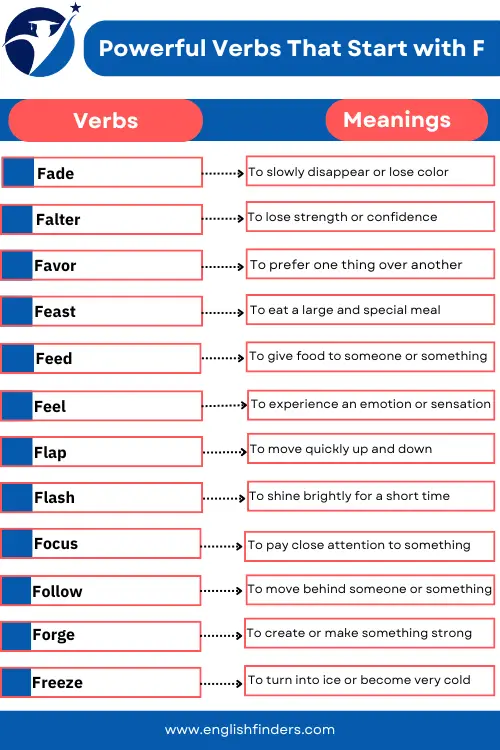
| Fade | To slowly disappear or lose color | The paint on the wall has begun to fade. |
| Fail | To not succeed | I failed my English test, but I’ll study harder next time. |
| Fall | To drop down quickly | Leaves fall from the trees in autumn. |
| Fancy | To want or like something (mainly British) | I fancy a slice of chocolate cake. |
| Fasten | To attach or close something firmly | Please fasten your seatbelt. |
| Favor | To prefer one thing over another | I favor chocolate ice cream over vanilla. |
| Fear | To be afraid of something | Many kids fear the dark. |
| Feast | To eat a large, special meal | We feasted on fried rice and chicken at the party. |
| Feed | To give food to someone or something | Please feed the cat before you leave. |
| Feel | To experience an emotion or a sensation | I feel happy when I’m with my friends. |
| Fetch | To go and bring something back | Could you fetch my backpack from the car? |
| Fight | To use force against someone, or to argue | The two brothers often fight over the TV remote. |
| File | To organize or store papers | I need to file these homework sheets. |
| Fill | To make something full | Please fill my water bottle. |
| Film | To record moving pictures | They filmed the school play last night. |
| Find | To discover something | I found a lost puppy outside. |
| Finish | To complete something | I finished my homework early today. |
| Fire | To shoot, or to dismiss someone from a job | The company fired two workers last month. |
| Fish | To try to catch fish | We love to fish at the lake every summer. |
| Fit | To be the right size or shape | These shoes fit me perfectly. |
| Fix | To repair something broken | Can you fix my broken phone? |
| Flap | To move quickly up and down | The bird flapped its wings and flew away. |
| Flash | To shine brightly for a short time | Lightning flashed across the sky. |
| Flatten | To make something flat | Please flatten the boxes before recycling. |
| Flee | To run away from danger | The thief tried to flee from the police. |
| Flick | To hit or move something lightly | He flicked the bug off his arm. |
| Float | To stay on top of water or air | The balloons floated into the sky. |
| Flood | To cover with too much water | The heavy rain flooded the streets. |
| Flow | To move smoothly, like water | The river flows gently to the sea. |
| Fly | To move through the air | Birds can fly high above the trees. |
| Focus | To pay close attention to something | Please focus on your reading. |
| Fold | To bend something so one part covers another | I folded the letter neatly. |
| Follow | To go behind someone or something | Please follow me to the library. |
| Forbid | To not allow something | My parents forbid me from staying out late. |
| Force | To make someone do something, or to use strength | He forced the door open. |
| Forget | To not remember something | I forgot to do my homework. |
| Forgive | To stop being angry with someone | I forgave my brother after our argument. |
| Form | To make or shape something | Clouds form interesting shapes. |
| Freeze | To turn into ice or become very cold | Water freezes at zero degrees Celsius. |
Stronger and Academic F Verbs
These verbs are less common in conversation. They are useful in essays, reports and at work.
| Verb | Meaning | Example Sentence |
|---|---|---|
| Fabricate | To invent something false, such as a story | He tried to fabricate an excuse to avoid trouble. |
| Falter | To lose strength or confidence | His voice faltered during the speech. |
| Fascinate | To strongly interest someone | Space travel has always fascinated me. |
| Feature | To include as an important part | The movie features a famous actor. |
| Finalize | To complete the last details of something | Let’s finalize our science project today. |
| Firm up | To make something stronger or more certain | We firmed up our travel plans last night. |
| Flourish | To grow or develop well | Her business flourished last year. |
| Forecast | To say what will probably happen | Experts forecast heavy rain for tomorrow. |
| Forge | To create something strong, like a friendship | They forged a new friendship at summer camp. |
| Fortify | To make something stronger, especially against attack | They fortified the castle walls. |
| Foster | To encourage something to grow | The teacher fostered a love of reading in her students. |
Irregular Verbs in This List
Most verbs in the list add -ed in the past: fail → failed, fix → fixed. Twelve of them are irregular, so learn their forms by heart. For more, see our irregular verbs list.
| Base form | Past simple | Past participle |
|---|---|---|
| Fall | Fell | Fallen |
| Feed | Fed | Fed |
| Feel | Felt | Felt |
| Fight | Fought | Fought |
| Find | Found | Found |
| Flee | Fled | Fled |
| Fly | Flew | Flown |
| Forbid | Forbade | Forbidden |
| Forecast | Forecast (or forecasted) | Forecast (or forecasted) |
| Forget | Forgot | Forgotten |
| Forgive | Forgave | Forgiven |
| Freeze | Froze | Frozen |
Phrasal Verbs With F Verbs
A phrasal verb is a verb plus a small word like out, in or up. Together they have a new meaning.
| Phrasal Verb | Meaning | Example Sentence |
|---|---|---|
| Find out | To learn a fact | I need to find out when the bus leaves. |
| Figure out | To understand or solve something | I can’t figure out this math problem. |
| Fill in | To complete a form; also, to take someone’s place for a short time | Please fill in your name here. |
| Fill out | To complete a form (more common in American English) | Fill out this form and give it to the nurse. |
| Fall apart | To break into pieces | My old shoes are falling apart. |
| Fall behind | To not keep up with others | He fell behind in math after he was sick. |
| Fit in | To feel accepted in a group | It took her a month to fit in at her new school. |
| Follow up | To check on something later | I’ll follow up with an email tomorrow. |
F Verbs That Learners Often Confuse
| Verbs | What each one means | Examples |
|---|---|---|
| Fall / fail | Fall means to drop down. Fail means to not succeed. | Don’t fall on the ice. Don’t fail the exam. |
| Flee / fly | Flee means to run away (fled). Fly means to move through the air (flew). | They fled the fire. The bird flew away. |
| Find / found | Find means to discover (found, found). Found is also its own verb: to start an organization (founded). | I found my keys. She founded a school. |
| Forget / forgive | Forget means to not remember. Forgive means to stop being angry. | I forgot her name. I forgave her mistake. |
| Feel / fill | Feel has a long sound, like feet. Fill has a short sound, like fit. | I feel tired. Fill the glass, please. |
Check your answer
Quiz: Test Yourself
- What is the past simple of fly?
- “The river ______ gently to the sea.”
- “If you don’t study, you might ______ the exam.”
- Which verb means “to run away from danger”?
- “I need to ______ when the bus leaves.”
- What is the past participle of forget?
- “She ______ a new company in 2010.” She started it.
- Which verb fits best in a formal essay?
- “Her business ______ after she moved to a bigger shop.”
- In British English, “I ______ a slice of cake” means “I want a slice of cake.”
Key Takeaways
- Most everyday F verbs are short: find, feel, fix, fill and fly.
- Twelve verbs in this list are irregular, including fall, feel, find, fly and forget.
- Phrasal verbs like find out and figure out are very common in speech.
- Do not mix up fall and fail, or flee and fly.
- Use stronger verbs like flourish and fortify in essays and formal writing.
Now try the worksheet below. You can check your answers at the end or download the printable PDF.
Worksheet: Practice Your F-Verbs!
Use this worksheet to check how well you remember the verbs that start with F. Take your time and check your answers at the end.
A. Fill in the Blanks
Choose the correct F-verb from the word bank and fill in the blanks.
Word Bank: (fade, fix, follow, fetch, forgive, focus, flood, forge, finish, flee)
- Please ________ your homework before dinner.
- Can you ________ my jacket from the car?
- We need to ________ the broken chair.
- I will always ________ my dreams, no matter what.
- It’s important to ________ on your goals.
- The small river will ________ after heavy rain.
- You should learn to ________ others when they make mistakes.
- The thief tried to ________ from the police.
- After many years, they ________ a strong friendship.
- The colors in the old photo started to ________.
B. Match the Verbs to Their Meanings
The meanings are mixed up. Match each verb to its correct meaning.
| Verb | Meaning (mixed up) |
|---|---|
| 1. Fabricate | a. To turn into ice or become very cold |
| 2. Freeze | b. To encourage the growth of something |
| 3. Foster | c. To move quickly up and down |
| 4. Flap | d. To be afraid of something |
| 5. Fear | e. To invent something false, such as a story |
C. Create Your Own Sentences
Pick any 3 verbs that start with F from the list and write your own sentence for each one. Be creative!
D. Phrasal Verbs
Complete each sentence with find out, figure out, fill out or fall behind.
- Please ________ this form before your appointment.
- I can’t ________ how to open this box.
- If you miss too many classes, you will ________.
- Can you ________ what time the shop closes?
Answers
A. 1. finish, 2. fetch, 3. fix, 4. follow, 5. focus, 6. flood, 7. forgive, 8. flee, 9. forged, 10. fade
B. 1. e, 2. a, 3. b, 4. c, 5. d
C. Answers will vary. To get feedback on your sentences, paste them into our AI Writing Feedback tool.
D. 1. fill out, 2. figure out, 3. fall behind, 4. find out
Frequently Asked Questions
What are some common verbs that start with F?
Some of the most common are find, feel, finish, follow, forget and fix. Learners use these every day, so learn them first, then move on to harder verbs like flourish and fortify.
What are action verbs that start with F?
Action verbs describe something you can do or see: fly, fall, fight, fix, fill, fold, float and flee. Verbs like feel and forget describe the mind, not a physical action.
What is the past tense of fly, freeze and forget?
These are irregular verbs. Fly becomes flew (past simple) and flown (past participle). Freeze becomes froze and frozen. Forget becomes forgot and forgotten.
What is the difference between fall and fail?
Fall means to drop down: “Be careful, or you will fall.” Fail means to not succeed: “He failed the test.” Their past forms are fell and failed.
What phrasal verbs start with F?
Common ones are find out, figure out, fill in, fill out, fall apart, fall behind and fit in. For example: “I need to find out when the bus leaves.”
Is fancy a verb?
Yes. In British English, fancy often means to want something: “I fancy a cup of tea.” American speakers usually say “I feel like” or “I want” instead.
Related Articles

- Symbolism: Meaning, Common Symbols and Examples in Literature - October 11, 2026
- Imagery: Meaning, 7 Types and Examples in Writing - October 10, 2026
- Literary Devices: 30 Common Devices with Meanings and Examples - October 9, 2026