

Last updated on September 25th, 2026 at 09:00 pm
What Is the Grammar Translation Method?
Quick Navigation
The Grammar Translation Method (GTM) is a traditional way of teaching a foreign language through grammar rules and translation. Learners study rules, memorize vocabulary lists, and translate sentences and texts between their mother tongue and the target language.
The method grew out of the way Latin and Ancient Greek were taught in European schools.
In the late 18th and 19th centuries, teachers in Prussia applied the same approach to modern languages such as French and English. In the United States, it was even called the “Prussian Method.”
From the 1840s to the 1940s, the Grammar Translation Method dominated foreign language teaching in Europe. It is still used today, especially in classrooms where exams test reading, grammar, and translation rather than speaking.
Characteristics of the Grammar Translation Method
These are the main characteristics of the Grammar Translation Method:
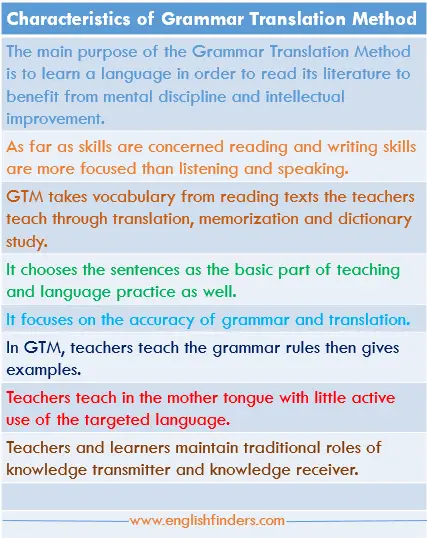
- Reading literature is the goal. Students learn the language to read its literature and to gain the mental discipline that comes from studying it.
- Reading and writing come first. Listening and speaking get little or no attention.
- Vocabulary comes from the reading texts. Teachers present it as bilingual word lists, which students learn through translation, memorization, and dictionary work.
- The sentence is the basic unit. Students translate and practice language one sentence at a time.
- Accuracy matters more than fluency. Students are expected to produce correct grammar and precise translations.
- Grammar is taught deductively. The teacher explains a rule first, and students then apply it to examples.
- The mother tongue is the classroom language. The target language is used mainly for reading and translation.
- The teacher is the authority. Students mostly listen, memorize, and follow instructions.
Objectives of the Grammar Translation Method
The main objective is to help learners read and understand literature written in the target language. Supporters also believed that studying grammar and translation trains the mind, much like studying mathematics.
In practical terms, the method aims to help students:
- read literary and academic texts written in the target language
- translate accurately from and into the target language
- master the grammar rules of the language, including their exceptions
- build a large written vocabulary
- improve their reading and writing skills
Techniques of the Grammar Translation Method
In Techniques and Principles in Language Teaching (2000), Diane Larsen-Freeman describes the classroom techniques most often used in the Grammar Translation Method:
- Translation of a literary passage: students translate a text from the target language into their mother tongue.
- Reading comprehension questions: students find information in the text, make inferences, and relate the text to their own experience.
- Antonyms and synonyms: students find words with opposite or similar meanings in the passage.
- Cognates: students learn to spot words that look and sound similar in both languages, and to watch out for “false friends.”
- Deductive application of rules: students learn a grammar rule and its exceptions, then apply it to new examples.
- Fill-in-the-blanks: students complete sentences with a missing word, such as a verb form or a preposition.
- Memorization: students memorize bilingual vocabulary lists, grammar rules, and verb conjugations.
- Using words in sentences: students write their own sentences with the new vocabulary.
- Composition: students write a short essay or summary on a topic from the reading text.
Grammar Translation Method Example: A Sample Lesson
Here is how a typical Grammar Translation Method lesson might look in an English class for learners whose first language is not English.
| Step | What the Teacher Does | What Students Do |
|---|---|---|
| 1. Reading | Hands out a short passage from an English story and explains new words in the mother tongue | Read the passage silently and underline unknown words |
| 2. Vocabulary | Writes a bilingual word list on the board, such as journey, village, and harvest | Copy the list and memorize the translations |
| 3. Grammar rule | Explains the past simple: regular verbs add “-ed” (walk → walked), while irregular verbs change form (go → went) | Take notes and learn the rule and its exceptions |
| 4. Practice | Gives fill-in-the-blank and translation sentences | Complete items such as “Yesterday she ___ (go) to the market.” |
| 5. Translation | Asks students to translate one paragraph into their mother tongue | Write a careful, accurate translation |
| 6. Checking | Corrects errors and gives the right answers | Compare their work with the teacher’s answers |
Notice that students hardly speak English during this lesson. Almost all communication happens in the mother tongue.
Advantages of the Grammar Translation Method
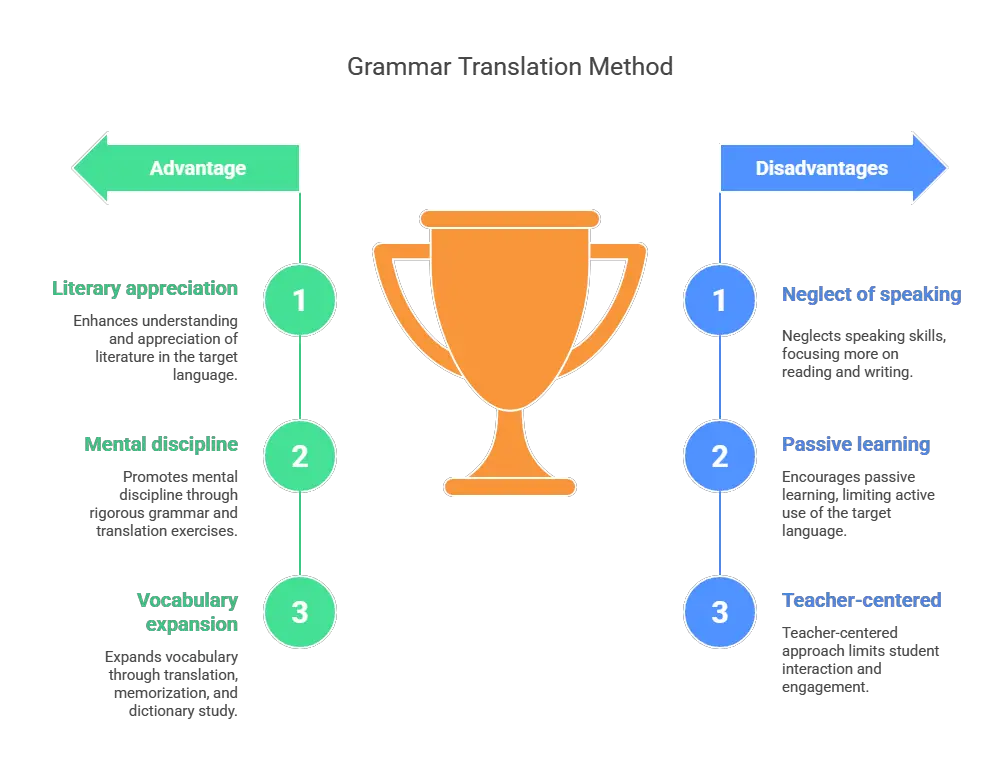
- Teachers do not need to be fluent speakers of the target language, so the method is easy to use where fluent teachers are rare.
- It works well with large classes, because most activities are written and teacher-led.
- Students develop a strong, accurate knowledge of grammar rules.
- Learners build a large reading vocabulary and can handle complex written texts.
- Translation shows learners exactly how their first language and the target language differ.
- Progress is easy to measure with written grammar and translation tests.
Disadvantages of the Grammar Translation Method
- Students get very little practice in speaking and listening.
- It is teacher-centered, so learners rarely interact with each other or use the language to communicate.
- Accuracy is valued over fluency, which can make students afraid of mistakes when they speak.
- Heavy memorization and rule learning can make lessons repetitive and demotivating.
- Constant translation trains students to think in their mother tongue first, which slows down real-time conversation. See how to learn English without translation.
- Learners may read and write well but still struggle with everyday conversation.
Grammar Translation Method vs Communicative Language Teaching
Communicative Language Teaching (CLT) developed in the 1970s, partly as a reaction against grammar-focused methods like GTM. The table below shows the main differences.
| Feature | Grammar Translation Method | Communicative Language Teaching |
|---|---|---|
| Main goal | Reading literature and learning grammar | Communicating in real situations |
| Main skills | Reading and writing | All four skills, especially speaking and listening |
| Classroom language | Mother tongue | Target language |
| Grammar teaching | Deductive (rule first) | Mostly inductive, learned in context |
| Focus | Accuracy | Fluency and meaning |
| Teacher’s role | Authority and source of knowledge | Facilitator and guide |
| Typical activity | Translating a literary passage | Role-play, pair work, and discussion |
To learn more about the alternative, read our guide to communicative language teaching.
Final Thoughts
The Grammar Translation Method has clear limits, especially for speaking and listening. Still, it gives learners a solid grasp of grammar, a rich reading vocabulary, and strong translation skills.
Many teachers today borrow parts of it, such as short translation tasks or clear grammar explanations, and combine them with communicative activities.
Frequently Asked Questions
What is the Grammar Translation Method in simple words?
It is a way of teaching a foreign language by explaining grammar rules, memorizing vocabulary lists, and translating texts between the learner’s mother tongue and the target language. Reading and writing are the main focus.
Who introduced the Grammar Translation Method?
No single person invented it. It grew from the teaching of Latin and Greek and took shape in 18th- and 19th-century Prussia, through textbook writers such as Johann Seidenstücker, Karl Plötz, and H. S. Ollendorf.
What are the main characteristics of the Grammar Translation Method?
A focus on reading and writing, bilingual vocabulary lists, deductive grammar teaching, sentence-by-sentence translation, use of the mother tongue in class, and a strong emphasis on accuracy over fluency.
What are the advantages and disadvantages of the Grammar Translation Method?
It builds accurate grammar, reading vocabulary, and translation skills, and it suits large classes. However, it offers little speaking and listening practice, so learners often struggle in real conversations.
Why is it called the Grammar Translation Method?
Because its two main activities are learning grammar rules and translating sentences and texts. It was also called the Classical Method, since it began with the teaching of Latin and Greek.
Is the Grammar Translation Method still used today?
Yes. It is still common where exams test grammar, reading, and translation, and in the study of classical languages. Many teachers now mix it with communicative activities.
Related Articles

- Ad Hominem: Meaning, Types and Examples of the Fallacy - October 7, 2026
- Slippery Slope Fallacy: Meaning, Types and Examples - October 7, 2026
- Logical Fallacies: 15 Common Types with Examples - October 6, 2026


It was very useful for me to know about the characteristics of Grammar Translation Method, Thank you very much!
You’re welcome!