Last updated on September 11th, 2026 at 11:57 am
English is one of the most widely spoken languages in the world. It is used in many different contexts, from business to casual conversations. Knowing a few English phrases can be immensely helpful in our daily life.
Many common English sentences are used in our everyday situations. Here we will explore 100 effective English sentences used in daily life.
These sentences are helpful for everyday conversations and will help you to communicate more effectively in English. Whether you are a beginner or an advanced speaker, these sentences will assist you in improving your English speaking skills and expanding your vocabulary.
With regular practice, you will be able to communicate more fluently in English and better understand the language.
100 English Sentences Used in Daily Life
Quick Navigation
Now let us see the 100 effective English sentences used in daily life.
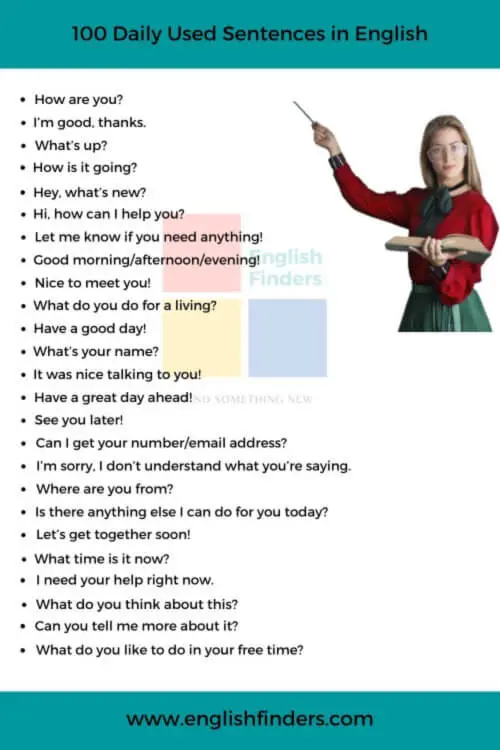
- How are you?
- I’m good, thanks.
- What’s up?
- How is it going?
- Hey, what’s new?
- Hi, how can I help you?
- Let me know if you need anything!
- Good morning/afternoon/evening!
- Nice to meet you!
- What do you do for a living?
- Have a sunny morning!
- What’s your name?
- It was nice talking to you!
- Have a great day ahead!
- See you later!
- Can I get your number/email address?
- I’m sorry, I don’t understand what you’re saying.
- Where are you from?
- Is there anything else I can do for you today?
- Let’s get together soon!
- What time is it now?
- I need your help right now.
- What do you think about this?
- Can you tell me more about it?
- What do you like to do in your free time?
- Could you please explain it to me?
- Can I have your opinion on this matter?
- What do you think is the best solution for this problem?
- Do you have any questions for me?
- I want to go on a trip.
- Please meet me in the afternoon.
- Have a safe journey!
- Can I reach you if I need help?
- What can I do to make things better?
- Do you have any suggestions on how to improve this situation?
- How did that make you feel?
- I feel pleasure to meet you after a long time.
- Have a nice weekend!
- How was your day?
- How can I reach you?
- Do you need any help?
- Could you repeat that, please?
- I’m looking for a job.
- We’re going to arrange a wedding party.
- Do you like to travel?
- That sounds great!
- I’ll get back to you as soon as possible.
- I’m happy to help in any way I can.
- Can I get your phone number?
- What’s your email address?
- I’m looking forward to it.
- What time should we meet up?
- Can I have a look at it?
- I need to buy some groceries.
- Do you mind if I join in?
- Let’s go out for dinner tonight.
- Sorry, I didn’t catch that.
- I’m running late; sorry for the inconvenience.
- Can we reschedule our meeting for tomorrow morning?
- I want to make a reservation at the restaurant.
- Which way should I go to get there?
- Would you like something to drink?
- Can I borrow your pen, please?
- It’s been a pleasure talking to you.
- I’ll call you later this evening.
- I don’t understand what you said.
- Let me know if there’s anything else I can do for you.
- Can I have your email address, please?
- It was nice meeting you today.
- Have a good day!
- What do you think about this idea?
- Let’s discuss it further tomorrow.
- What have you been up to?
- It’s been a while.
- It’s nice to see you again.
- I’m doing well, thanks for asking.
- I’m happy to see you.
- It’s good to hear from you.
- I hope all is well with you.
- Can I help you with something?
- Do you need any assistance?
- Would it be possible to schedule an appointment with the manager tomorrow afternoon?
- Do you have any other questions or concerns?
- I want to get more information about this product before deciding.
- Are there any discounts available on this item?
- Could we go over the details of the contract again?
- Can I estimate how long it will take to complete the project?
- Could we arrange a call sometime next week?
- What are some of the benefits of using this service?
- Do you have any recommendations or suggestions on how to improve the process?
- What did you think of that experience?
- Is there anything else I should know about this topic?
- Do you have any advice for me on how to handle this situation?
- Would it be possible for us to meet and discuss this further in person?
- Could we schedule a time to discuss this issue over the phone/Skype/email/etc.?
- Can other resources or people help us with this issue further down the line if needed?
- What are your thoughts on the current state of affairs?
- What do you think would be the best way forward?
- Could we develop a better solution than what we currently have?
- What are some of the challenges we might face in implementing such a plan?
The following are some of the most commonly used sentences in English. As you can see, there are many types of sentences that you can use in a conversation. While these 100 commonly used sentences are a great start, you can expand your vocabulary. Happy reading!
Tips for Using These Sentences
- Practice them out loud: Reading a sentence silently is not the same as saying it. Practice these sentences aloud so they become natural to say, not just recognize.
- Adapt them to your own situations: Swap in your own name, job, or plans so each sentence becomes something you’d genuinely say, not just a memorized line.
- Start with the ones you’ll use most: Greetings and everyday questions near the start of the list come up constantly; master those first before moving on to the more formal, business-style sentences later in the list.
Frequently Asked Questions
What are some common English sentences for daily use?
Common daily-use sentences include greetings like ‘How are you?’, everyday questions like ‘What time is it now?’, and polite requests like ‘Could you please explain it to me?’ See the full list of 100 above.
How can I practice these English sentences effectively?
Say each sentence aloud, adapt it to your own life by swapping in your own details, and focus first on the greetings and everyday questions you’re most likely to actually use.
Are these sentences suitable for beginners?
Yes. The list moves from simple greetings and small talk toward more advanced requests and business-style sentences, so beginners can start at the top and work their way through.
Can I use these sentences in both spoken and written English?
Most of these sentences work well in everyday spoken conversation. Some of the more formal, business-oriented sentences later in the list also work well in emails and written messages.
How many sentences do I need to know to speak English fluently?
There’s no fixed number, but building a base of 100 to 200 commonly used sentences, like the ones on this page, gives you a strong foundation for everyday conversation.
What’s the best way to remember these sentences long-term?
Review a small group of sentences at a time, use them in real conversations as soon as possible, and revisit ones you’ve forgotten every few days rather than trying to memorize all 100 at once.
Related Articles

- Imagery: Meaning, 7 Types and Examples in Writing - October 10, 2026
- Literary Devices: 30 Common Devices with Meanings and Examples - October 9, 2026
- Bandwagon Fallacy: Meaning, Examples and Origin - October 8, 2026