
Last updated on September 12th, 2026 at 10:06 am
The present perfect tense trips up a lot of English learners at first, mostly because it doesn’t translate neatly into other languages. The good news is that once you see the pattern, it becomes second nature.
The present perfect tense is a verb tense used to refer to actions or events that occurred in the past but have a connection to the present. It is formed by combining the auxiliary verbs “have, has” with the past participle of the main verb.
For example, “I have finished my homework” indicates that the action of finishing homework occurred at some point in the past, but the speaker is still in the present. The completion of the homework has relevance to the present moment.
The present perfect tense is also used to describe experiences or changes that have occurred over a period of time leading up to the present. In this article, we’ll explore 20 useful Present Perfect Tense Exercises with Answers.
Structure of the Present Perfect Tense
Quick Navigation
Before you start the exercises, it helps to have the basic formula in front of you:
| Form | Structure | Example |
|---|---|---|
| Affirmative | Subject + have/has + past participle | She has finished the report. |
| Negative | Subject + have/has + not + past participle | She has not finished the report. |
| Interrogative | Have/Has + subject + past participle | Has she finished the report? |
20 Present Perfect Tense Exercises with Answers
Here are 20 exercises to help you improve your skills in the English language.
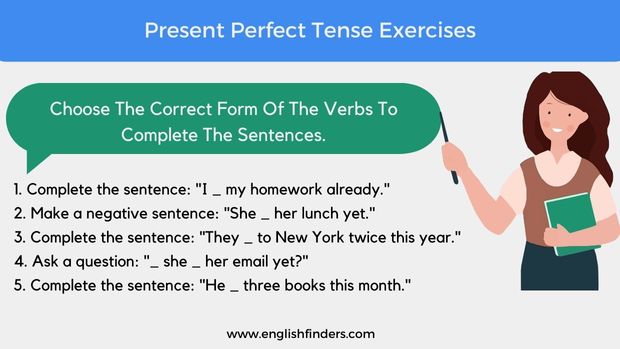
- Complete the sentence: “I _ my homework already.”
Answer: have done - Make a negative sentence: “She _ her lunch yet.”
Answer: hasn’t had - Ask a question: “_ you _ your keys?”
Answer: Have, found - Complete the sentence: “They _ to New York twice this year.”
Answer: have been - Make a negative sentence: “I _ my phone all day.”
Answer: haven’t used - Ask a question: “_ she _ her email yet?”
Answer: Has, checked - Complete the sentence: “He _ three books this month.”
Answer: has read - Make a negative sentence: “We _ any problems with the project so far.”
Answer: haven’t had - Ask a question: “_ they _ the meeting yet?”
Answer: Have, scheduled - Complete the sentence: “She _ for that company for five years.”
Answer: has worked - Make a negative sentence: “He _ his car since last week.”
Answer: hasn’t used - Ask a question: “_ you _ your passport yet?”
Answer: Have, received - Complete the sentence: “They _ to Paris many times.”
Answer: have been - Make a negative sentence: “I _ any coffee today.”
Answer: haven’t had - Ask a question: “_ she _ the movie already?”
Answer: Has, seen - Complete the sentence: “He _ his homework yet.”
Answer: hasn’t done - Make a negative sentence: “We _ any luck finding a new apartment.”
Answer: haven’t had - Ask a question: “_ they _ the report yet?”
Answer: Have, finished - Complete the sentence: “She _ her hair three times this year.”
Answer: has dyed - Make a negative sentence: “They _ any progress on the project yet.”
Answer: haven’t made
Final Thoughts
These exercises are a starting point, not the finish line. Try weaving the present perfect into your everyday conversations and writing, and the pattern will start to feel automatic.
The key thing to hold onto is that the present perfect links a past action to a result you can still see or feel right now. Make a few mistakes along the way — that’s a normal part of learning any tense.
Frequently Asked Questions
What is the present perfect tense used for?
It links a past action to the present moment — either because the action just happened, its result still matters, or it describes an experience or change over time, as in “I have visited Paris.”
What is the structure of the present perfect tense?
Subject + have/has + past participle, for example “She has finished the report.” Use “has” with he/she/it and “have” with I/you/we/they.
How do you make the present perfect negative?
Add “not” after have/has, or use the contractions “haven’t” or “hasn’t”: “She hasn’t finished the report yet.”
What signal words go with the present perfect tense?
Common ones include already, yet, just, ever, never, since, and for — as in “I have never been to Japan” or “We have lived here since 2019.”
How is present perfect different from simple past?
Simple past (“I finished my homework”) refers to a completed action at a specific past time. Present perfect (“I have finished my homework”) leaves the exact time unstated and focuses on the result now.
Are these present perfect exercises suitable for beginners?
Yes. The 20 exercises move from simple fill-in-the-blank sentences to short questions, so they work well for beginners and as review practice for more advanced learners.
Related Articles

- Antithesis: Meaning, Examples and the Grammar of Balance - October 17, 2026
- Anaphora: Meaning, Examples and How to Use It - October 17, 2026
- Flashback: Meaning, Examples and How to Write One - October 16, 2026