
Last updated on October 14th, 2026 at 07:03 am
Yesterday I cooked dinner. Right now I am cooking dinner. Tomorrow I will cook dinner. The verb is the same, but the form changes with the time. That change is called tense.
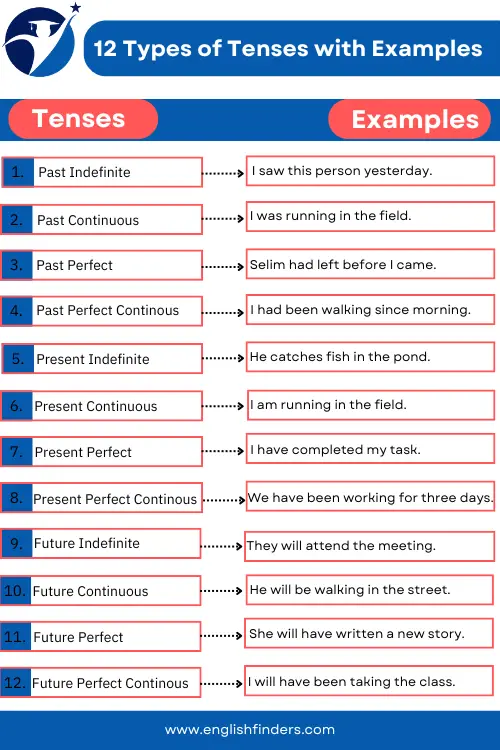
English has 12 types of tenses. This lesson shows all of them in one chart, with a formula and examples for each tense. Then you can practice with exercises, a quiz and a FAQ.
- What a tense is, and why English has 12 types
- A chart of all 12 tenses with an example for each
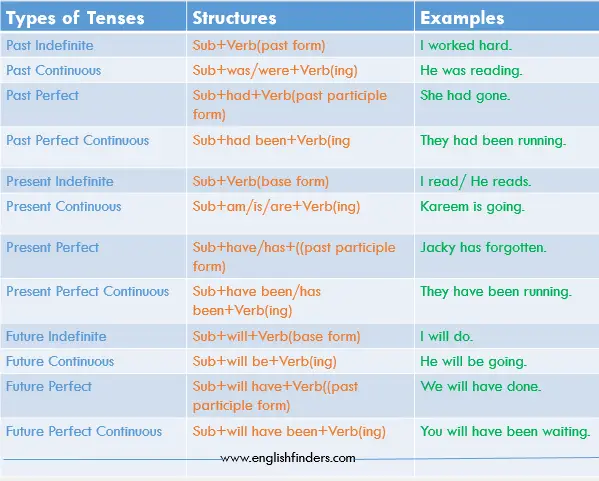
- The formula, the main use and three examples of every tense
- How to choose the right tense for a sentence
- The most common mistakes, plus exercises and a quiz
What Is Tense in English Grammar?
Quick Navigation
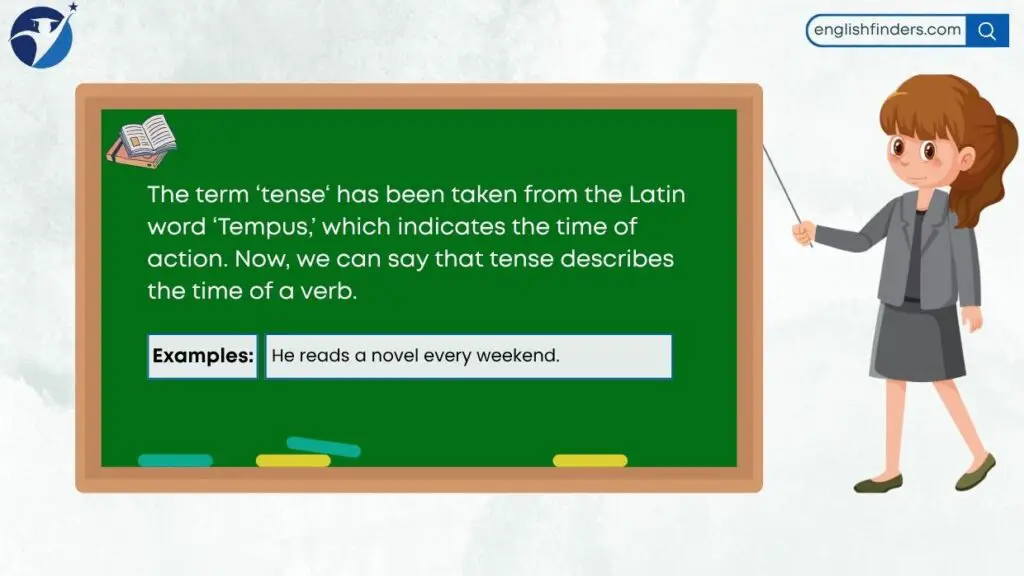
Tense is the form of a verb that shows when an action happens. The word comes from the Latin word tempus, which means time. A tense tells us if the action is in the past, in the present or in the future.
Look at three sentences:
- I bought a book. (past)
- He reads a novel. (present)
- She will meet her friends. (future)
Each sentence has a different verb form, and each form points to a different time.
Three Times and Four Aspects
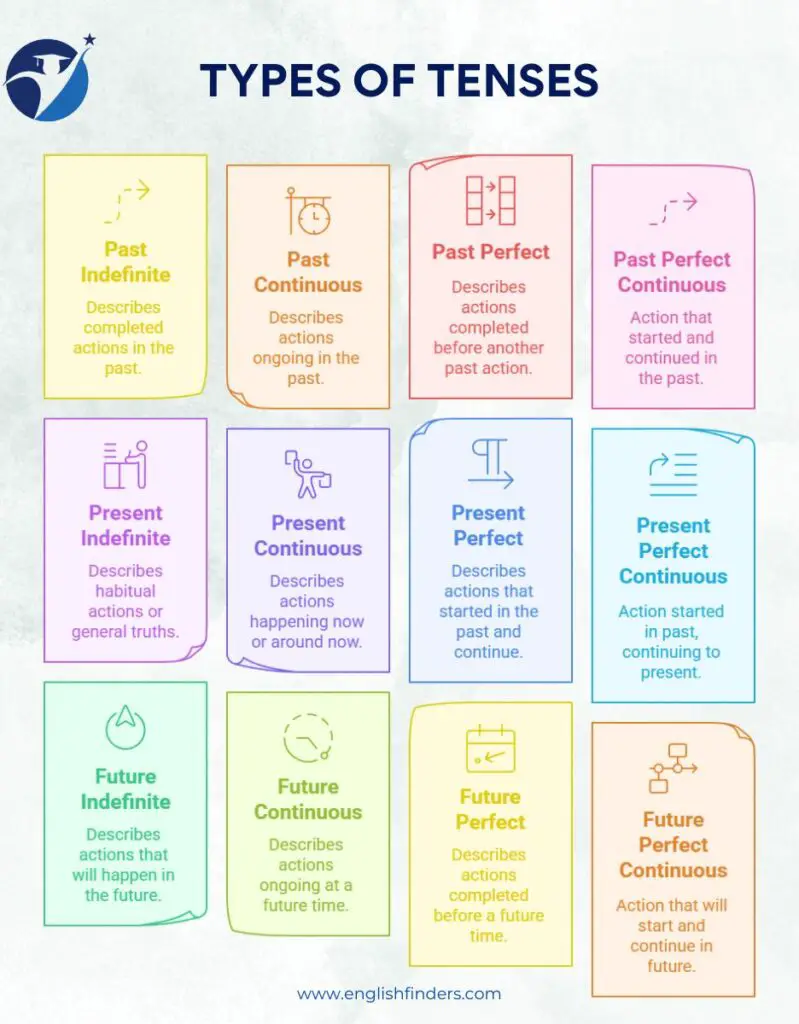
There are three main types of tenses: past, present and future. Each one has four aspects. An aspect shows how the action happens in that time.
- Simple (indefinite): a fact, a habit or a finished action
- Continuous: an action in progress
- Perfect: an action finished before another point in time
- Perfect continuous: an action that has been going on for some time
Three times and four aspects give 12 tenses. The chart below shows them all.
The 12 Types of Tenses: Chart with Examples
| Aspect | Past | Present | Future |
|---|---|---|---|
| Simple | I walked. | I walk. | I will walk. |
| Continuous | I was walking. | I am walking. | I will be walking. |
| Perfect | I had walked. | I have walked. | I will have walked. |
| Perfect continuous | I had been walking. | I have been walking. | I will have been walking. |
Some teachers say indefinite and others say simple. They mean the same thing. For example, past indefinite and simple past are one tense.
Past Tenses
1. Past Simple (Past Indefinite) Tense
Formula: subject + past verb
We use it for finished actions in the past and for past habits.
- She described her story.
- I saw this person yesterday.
- They cooked biryani last night.
Questions and negatives use did: Did you see him? I did not see him. Read the full guide to the past indefinite tense.
2. Past Continuous Tense
Formula: subject + was/were + verb-ing
We use it for an action that was in progress at a time in the past.
- I was running in the field.
- They were playing cricket at five o’clock.
- Rima was talking to her friend.
Use was with I, he, she and it. Use were with you, we and they. See the past continuous tense guide.
3. Past Perfect Tense
Formula: subject + had + past participle
We use it for the earlier of two past actions.
- Selim had left before I came.
- She had cooked dinner before the guests arrived.
- He had bought some clothes before the shop closed.
Read more about the past perfect tense.
4. Past Perfect Continuous Tense
Formula: subject + had been + verb-ing
We use it for an action that continued up to a point in the past. Words such as for and since often show how long.
- I had been walking since morning.
- He had been reading the book for one week.
- They had been waiting for two hours before the bus came.
Find more in 50 examples of the past perfect continuous tense.
Present Tenses
5. Present Simple (Present Indefinite) Tense
Formula: subject + base verb (add -s or -es for he, she and it)
We use it for habits, facts and general truths.
- I read poetry every night.
- She dances well.
- The sun rises in the east.
Questions and negatives use do or does: Does she dance? She does not dance. Read the present indefinite tense guide.
6. Present Continuous Tense
Formula: subject + am/is/are + verb-ing
We use it for actions happening now, temporary actions and near-future plans.
- I am writing an email now.
- They are staying at a hotel this week.
- We are flying to Paris next month.
See the present continuous tense guide.
7. Present Perfect Tense
Formula: subject + have/has + past participle
We use it for an action that happened at an unstated time, or an action with a result now.
- I have finished my homework.
- She has visited Japan twice.
- They have lost their keys.
Read more about the present perfect tense.
8. Present Perfect Continuous Tense
Formula: subject + have/has been + verb-ing
We use it for an action that began in the past and is still going on, or has just stopped.
- I have been learning English for three years.
- He has been working since eight o’clock.
- It has been raining all day.
See the present perfect continuous tense guide.
Future Tenses
9. Future Simple (Future Indefinite) Tense
Formula: subject + will + base verb
We use it for decisions, promises and predictions about the future.
- I will call you tomorrow.
- It will rain tonight.
- She will join us for lunch.
Read the future indefinite tense guide.
10. Future Continuous Tense
Formula: subject + will be + verb-ing
We use it for an action that will be in progress at a time in the future.
- This time tomorrow, I will be flying to Dubai.
- She will be sleeping at ten o’clock.
- We will be waiting for you at the station.
See the future continuous tense guide.
11. Future Perfect Tense
Formula: subject + will have + past participle
We use it for an action that will be finished before a point in the future.
- I will have finished my work by six o’clock.
- They will have left before you arrive.
- She will have graduated by next June.
Find more in 50 examples of the future perfect tense.
12. Future Perfect Continuous Tense
Formula: subject + will have been + verb-ing
We use it to show how long an action will have continued by a future time.
- By May, I will have been working here for five years.
- He will have been driving for six hours by noon.
- They will have been living in Canada for a year next month.
Find more in 50 examples of the future perfect continuous tense.
How to Choose the Right Tense
Ask two questions. First, when does the action happen: past, present or future? Second, how do I see the action: as a fact, as in progress, as finished or as going on for some time?
| Question | Aspect to use | Example |
|---|---|---|
| Is it a fact, habit or finished event? | Simple | She works in a bank. |
| Is it in progress at that time? | Continuous | She is working now. |
| Is it finished before another time? | Perfect | She has worked here since 2020. |
| Has it continued for some time? | Perfect continuous | She has been working all day. |
Check your answer
Common Mistakes with Tenses
| Incorrect | Correct | Rule |
|---|---|---|
| I am knowing the answer. | I know the answer. | Verbs of state, such as know and like, do not take -ing. |
| She go to school every day. | She goes to school every day. | Add -s or -es for he, she and it in the present simple. |
| I didn’t went there. | I didn’t go there. | After did, use the base verb. |
| I have seen him yesterday. | I saw him yesterday. | Use the past simple with a finished time such as yesterday. |
| If it will rain, we stay home. | If it rains, we will stay home. | After if, use the present simple for the future. |
Practice: Exercises on the Types of Tenses
Exercise 1: Name the Tense
Write the name of the tense in bold.
- She has finished her homework.
- They were playing football at four o’clock.
- I will call you tonight.
- He had left before I arrived.
- We are studying English now.
- By June, she will have been teaching for ten years.
Show answers for Exercise 1
- Present perfect
- Past continuous
- Future simple
- Past perfect
- Present continuous
- Future perfect continuous
Exercise 2: Choose the Correct Form
Choose the correct verb.
- Water (boils / is boiling) at 100 degrees.
- I (saw / have seen) that film last week.
- Look! The baby (sleeps / is sleeping).
- She (has lived / lives) in Dhaka since 2015.
- When I arrived, the class (already started / had already started).
- This time next week, we (will lie / will be lying) on the beach.
Show answers for Exercise 2
- Boils (a general fact)
- Saw (a finished time: last week)
- Is sleeping (happening now)
- Has lived (since 2015 links the past to now)
- Had already started (earlier of two past actions)
- Will be lying (in progress at a future time)
Quiz: Test Yourself
- How many types of tenses are there in English?
- Which sentence is in the present continuous tense?
- What is the formula of the past perfect tense?
- Which sentence is correct?
- “By May, I will have been working here for five years.” Which tense is this?
- Which tense do we use for a general truth?
- Which sentence is correct?
- “She has been studying since morning.” Which tense is this?
- Which sentence shows the earlier action in the past?
- Which sentence is correct?
Key Takeaways
- Tense shows the time of an action. English has 12 tenses: three times and four aspects.
- The four aspects are simple, continuous, perfect and perfect continuous.
- Each tense has a formula, such as had + past participle for the past perfect.
- Choose the tense with two questions: when does the action happen, and how do I see it?
- Verbs of state, such as know and like, usually do not take -ing.
Frequently Asked Questions
What are the 12 types of tenses in English?
They are the simple, continuous, perfect and perfect continuous forms of the past, present and future. For example: I walked, I am walking, I will have walked.
How many types of tenses are there?
There are three main types: past, present and future. Each has four aspects, so there are 12 tenses in all.
What is the difference between simple and continuous tenses?
Simple tenses show facts, habits and finished actions. Continuous tenses show actions in progress. For example: She works here. She is working now.
When do we use the perfect tenses?
We use them for an action finished before another time, or for an action with a result now. For example: I have finished my homework.
Are indefinite and simple tenses the same?
Yes. Past indefinite and simple past are the same tense. Present indefinite and simple present are also the same.
What is the easiest way to learn all the tenses?
Learn the formula for each tense, then practice with short examples and time words such as yesterday, now and by next year.
Related Articles

- Synecdoche: Meaning, Pronunciation and Examples - October 20, 2026
- Metonymy: Meaning, Types and Examples in the News - October 20, 2026
- Figures of Speech: Meaning, Types and Examples - October 19, 2026
Thanku so much this opportunity ! I’m a graphic designer and worked in data entry… but my English is not strong . this website very helpful for me.!
Again thanku
Welcome