
Worksheet 7: Abilities & Free Time
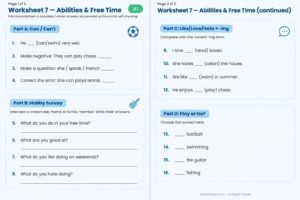
Print this page, or complete it right here online. The answer key is at the bottom: try every part first.
Part A – Can / can’t
- He ___ (can / swim) very well.
- Make negative: They can play chess. _____
- Make a question: she / speak / French _____
- Correct the error: She can plays tennis. _____
Part B – Hobby survey
Interview a classmate, friend, or family member. Write their answers.
- What do you do in your free time? _____
- What are you good at? _____
- What do you like doing at the weekend? _____
- What do you hate doing? _____
Part C – Like / love / hate + -ing
Complete with the correct -ing form.
- I love ___ (read) books.
- She hates ___ (clean) the house.
- We like ___ (swim) in summer.
- He enjoys ___ (play) chess.
Part D – Play or go?
Choose the correct verb.
- ___ football
- ___ swimming
- ___ the guitar
- ___ fishing
Part E – Extra practice (online): good at
Complete with at and the correct form of the verb.
- My brother is good ___ ___ (draw).
- I’m not very good ___ ___ (sing).
- Are you good ___ ___ (cook)?
Answer Key
Part A: 1. can swim · 2. They can’t play chess. · 3. Can she speak French? · 4. She can play tennis.
Part B: 5–8. Personal answers: check the grammar (for example, “She likes dancing”, “He’s good at football”).
Part C: 9. reading · 10. cleaning · 11. swimming · 12. playing
Part D: 13. play · 14. go · 15. play · 16. go
Part E: 17. at drawing · 18. at singing · 19. at cooking
Connect
Review can, like + -ing and play/go with our Grammar Quiz (A1).
CEFR A1 — Spoken Interaction / Vocabulary: I can ask and answer simple questions about abilities and hobbies.

- Imagery: Meaning, 7 Types and Examples in Writing - October 10, 2026
- Literary Devices: 30 Common Devices with Meanings and Examples - October 9, 2026
- Bandwagon Fallacy: Meaning, Examples and Origin - October 8, 2026
Reading as a guest. Create a free account or log in to save your progress, mark lessons complete and earn a certificate.